%20Text%20(Violet).png)
I have a sense of dejà vu as I begin this post. I know that, in the text and resources that follow, I will be writing a great deal about the development of evaluation skills in PE lessons and qualification PE and sport courses. Why do I feel this way? Because I have written extensively about the crucial importance of developing the evaluation skill previously.
-
I have written about how to teach the evaluation skill through commercialisation lessons in the blog: Teaching the commercialisation of sport in PE lessons
-
I have explicitly written about how I get PE students evaluating. This is in two parts:
Part 1: How I get my students evaluating in PE lessons (Part 1)
Part 2: How I get my students evaluating in PE lessons Part 2
-
And I have even specifically written about my three favourite activities for evaluation skills.
A reader might legitimately wonder why this fellow James is writing about evaluation again.
Well, put bluntly. Since the specifications of 2016 came on stream, evaluating technological developments in courses such as GCSE PE, A-level PE, BTEC and Cambridge National courses has been a very common experience and, as I have mentioned previously in the blog "Teaching the commercialisation of sport in PE lessons", cannot be taught by simply telling students what advantages and disadvantages they need to know (see the blog "Eight Things I will Never Say in a School" for more detail on this).
The nature of technology lessons in PE
Teaching PE students a static list of positives and negatives about technology does not mean that our PE students are learning to evaluate. Because of the very nature of technology, the technology topic changes over time. Therefore, simply learning the positives and negatives of a particular technology will not cut it. Take, for example, the natural appearance of AI analysis on PE and Sport mark schemes in 2026. I guarantee you that AI will be credited in numerous contexts this summer, and, as such, the key aspect for the PE student is to be skilled enough to evaluate any form of technology in the context of sport.In other words, when we teach technology lessons in PE, we are actually teaching about how to evaluate.
So, what should we avoid doing in our technology lessons? I have taught exactly the lesson format below myself, more times than I care to admit. It feels orderly, efficient and ‘spec‑covering’, which is precisely why it’s so seductive.In my opinion, this is not the approach to take:
❌ 1. Starter activity naming technology types
❌ 2. 20-minute presentation from the teacher based on the strengths and weaknesses of technology
❌ 3. A worksheet highlighting different strengths and weaknesses in relation to different entities, such as the performer, the coach, the official, etc.
❌ 4. Past paper exam question practice on technology
❌ 5. Plenary
In the lesson I have outlined above, the student is expected to do little to no evaluation whatsoever. They are observing evaluative lists and concepts, but they are not experiencing them as learners. Evaluation happens in the minds of PE and Sport students. It does not happen because we put lists of green and red items on a slide and present them on the big screen.
Consider when, in your own life, you are most evaluative. Think about when and why you change your opinion about something. Think about when and how you receive new information, and that information helps you to deviate from an established position about a concept. I hazard a guess that, when this happens, it is because you engage with the ideas and play with them in your mind. Our PE students have the right to experience the same.
How to do it evaluatively
Let’s assume you are teaching OCR A-level PE and you are drawing to the latter stages of the Contemporary Issues unit 3.2. Let’s assume you are planning your lessons on the impact of technology on various aspects of sport and physical activity: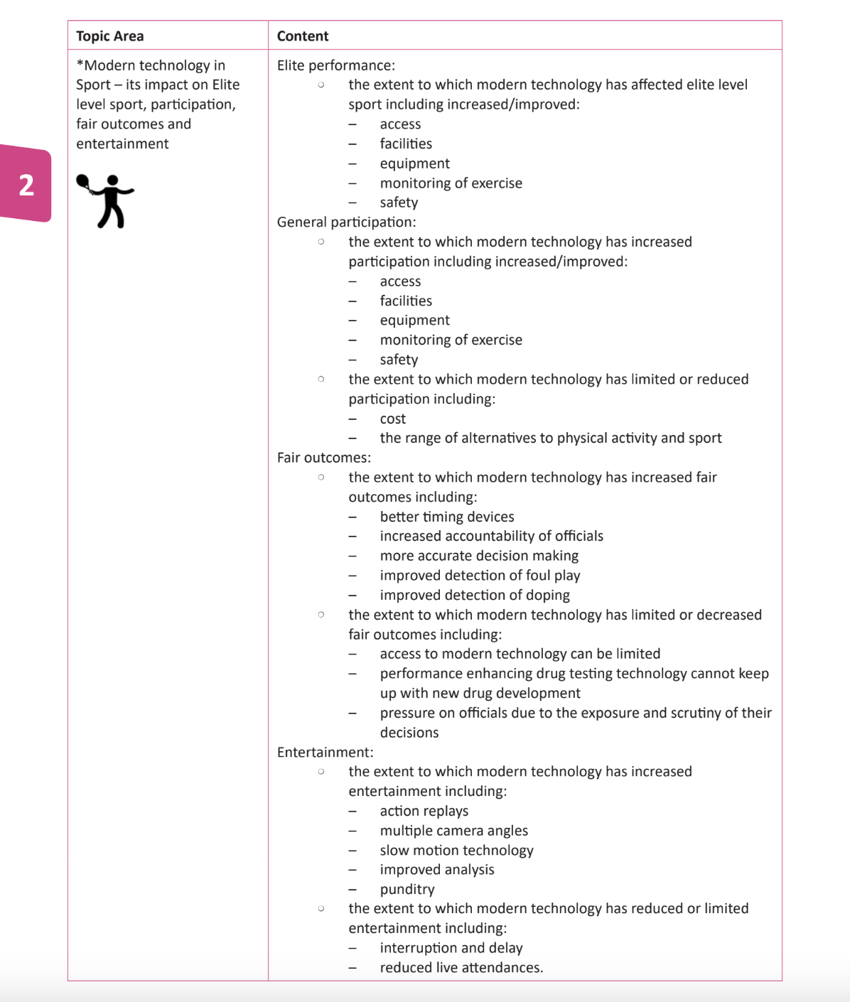
How should you go about delivering this in lessons? I’ve already mentioned what, perhaps, not to do. What then should one do?
The simple answer to this (which I will extrapolate further down) is to encourage the students to actively evaluate. But to do so in a format designed for that outcome.
I would approach this lesson or pair of lessons with this target:
Develop evaluative thinking and writing, including the need to develop well-considered and balanced conclusions, through the OCR A-level PE technology content.
By the end of the lesson, students will have:- Constructed a balanced argument about one technology impact area using at least two positives and two negatives.
- Used a chosen conclusion format to reach a clear judgment.
- Attempted one six‑mark question independently using the ‘Evaluate’ roadmap.
Please take a moment to consider this objective. At first glance, it may seem generic, but, in fact, it is hyper-specific. From this target, it is clear to see that both thinking and writing evaluatively are success criteria. It is clear that a further success criterion is the need for the students to consider and develop skills in forming conclusions.
So, what might the lesson(s) look like?
If you look over my guidance on teaching commercialisation in PE lessons, you will be able to see an exact lesson plan with individual, specific activities at each stage. Rather than repeating many of those elements here, I want to give a more metacognitive overview of a technology lesson in PE.
In my opinion, a technology lesson should have three approximate phases, not including considerations such as pre-learning, starters, plenaries and homework.
Phase 1 - Introducing the format of evaluation explicitly
Early in a lesson on technology, a PE teacher should definitely introduce the evaluation skill to the students explicitly. There are many ways to do this. In my case, I am going to introduce one single slide, the only from-the-front-teaching I am going to do, as a setup for phase 2. My slide is probably going to look something like this: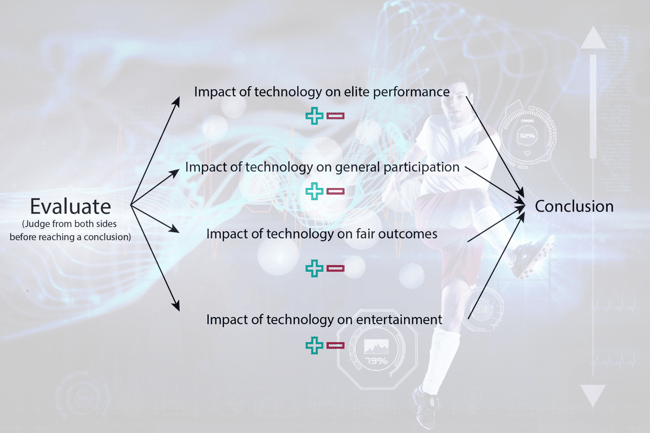
PE students should learn, explicitly, that evaluation involves judging from both sides and then reaching a conclusion. Technology and lessons about technology offer a prime opportunity to do this, just as lessons on the components of fitness or classification offer great opportunities to learn the ‘Justify’ skill and lessons on health or the energy systems offer great opportunities to learn the ‘Analyse’ skill.
PE teachers have the opportunity to go further in phase 1 by introducing The Roadmap language or by introducing that equivalent language on an extended-writing frame. Here is the example that I am likely to use in my own teaching:
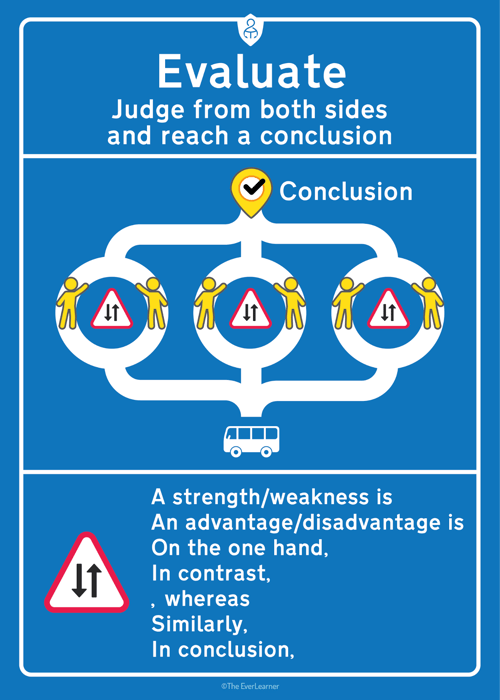
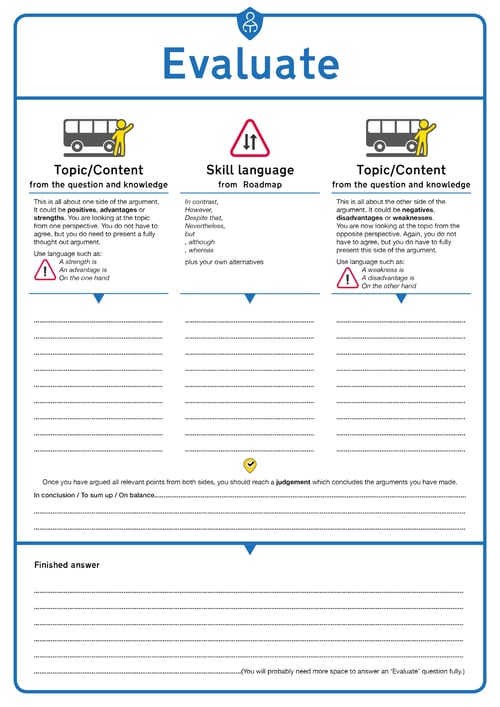
The Evaluate Roadmap and Roadmap Writing Framework.
Introducing this writing framework in Phase 1 establishes a setup for phase 3, as well as encouraging the students to think evaluatively in Phase 2.
Phase 2 - Behaving evaluatively
There are a few different ways to do this, and I detail all of them in a previous blog post on evaluative activity structures. But, in almost all cases, I will use either an agreement circles activity or a folded lines activity. Sometimes I will use both within the same lesson. In essence, these activities get the students evaluating actively. The objective in phase 2 is that students complete this evaluation, but also record all the elements of discussion in a central space for usage in Phase 3.
I tend to use a central whiteboard for the record of the evaluative ideas that the students develop. It might look something like this:
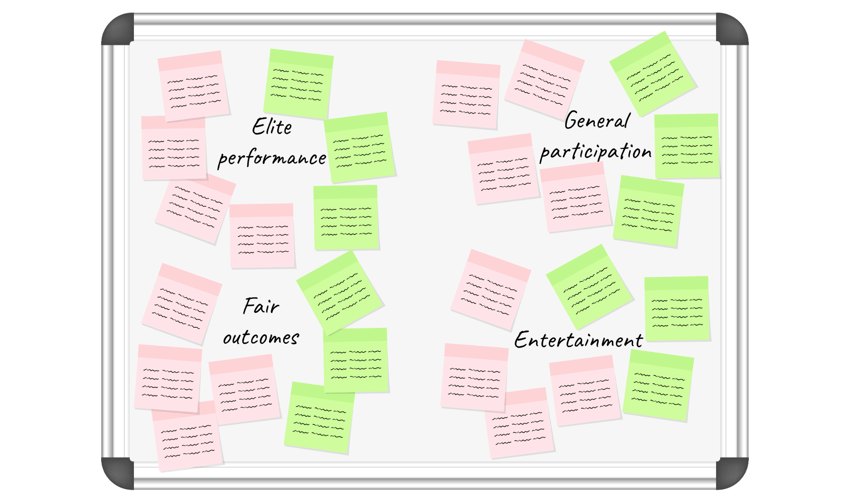
The central record of ideas is very, very important to the lesson(s). By maintaining this record of conversations, debates and arguments, Phase 3 of the lesson will be better-resourced.
I also want to add that the teacher processes in Phase 3 are very nuanced. Producing high-impact agreement circles or folded lines activity is very challenging and does take practice but the impact is worthwhile.
Phase 3 - Modelling evaluative writing through metacognition
Let us remind ourselves of our lesson aim:Develop evaluative thinking and writing, including the need to develop well-considered and balanced conclusions through the OCR A-level PE technology content.
At this stage, PE students need to start to hone in on the writing challenge. In my opinion, the best way to achieve this is through metacognitive modelling. I encourage PE teachers to use this framework:
- I do
- We do
- You do
Let’s keep things simple and imagine that the question we are going to focus on is:
Evaluate the impact of modern technology on fair outcomes in sport. (6 marks).
The role of the PE teacher, initially, would be to demonstrate to the students, in the “I do” stage, HOW to go about answering this question. Take your time here. Have the students in silence, maybe asking a few questions here and there, but show them HOW a master would answer the question. Emphasise things like:
- Highlighting/underlining command word, question focus and mark totals.
- Recognising that the question is not extended writing.
- Starting the first evaluative point from the very first word of the answer.
- Ensuring balance between positive and negative points.
- Using high-quality examples, impacts and outcomes of the technology (The E-I-O model).
- Reaching a balanced conclusion by selecting a specific conclusion format from a selection of five or six formats.
This might take a solid 10 minutes. Fine! Invest in this. Then, afterwards, move to the next question:
Evaluate the impact of modern technology on entertainment in sport. (6 marks).
This time, switch to the “We do” phase and have the students guide you on what to do. Ensure that the students do this. Make the process as collaborative as possible.Then, finally, pose a third question:
Evaluate the impact of modern technology on elite performance in sport. (6 marks).
And have the students complete this question themselves in the “You do” stage. Of course, it is also possible to have the group work on a fourth question, given the fact that we have four question groupings if you wish:Evaluate the impact of modern technology on general participation in sport. (6 marks).
Summary
I encourage you to take a step back at this moment and reflect on what I am suggesting. Nowhere in this lesson planning and discussion have I become focused on “covering content” or “getting through the spec”. Rather, that benefit is implicit within my lesson format. I have chosen to focus my lesson on the hard part of the technology topic, and that is resourcing the PE students with the evaluative skills they will need for this topic and many others.You may also sense a strong metacognition theme in my lesson planning. This is not accidental. When I teach PE lessons, I do not primarily view myself as a content-delivery device. Of course, I do a lot of explaining, coaching and guidance, but I have the confidence to know that this is going to happen in my lessons regardless. I have robust subject knowledge, and this will be transferred to the student. Definitely! But, importantly, I see my primary role as developing the skills of the PE students. I believe that A-level PE, say, is not a measure of a PE student’s subject knowledge but their capacity to apply metacognitive models to the challenges they face, including exam writing.
Choose one upcoming technology lesson and rebuild it around Phase 2 and Phase 3. Keep the same spec content, but change the student thinking demanded.
Conclusions
So, there you have it. This is my belief on how to teach the technology lesson within PE. I’m sure there will be readers who think I am being utopian or unrealistic, but I believe in what I have written above. This is what I do, and, hopefully, by sharing it, there might be some colleagues who reflect on their practices.Thank you for reading.
James