%20Text%20(Violet).png)
Dear PE colleagues,
The concepts of commercialisation and their impact on physical activity and sport in the UK and beyond are a fundamental part of the current PE teacher’s GCSE, A-level, Cambridge National and BTEC teaching load. But I am going to contest, within this post, that the quality of teaching that is being provided in these lessons could be significantly more impactful, with some reflections and learning considerations.
I wanted to write this post after my own daughter (a highly successful A-level PE student, now studying physiotherapy) fed back to me once:
“Dad, the socio stuff is really boring. It’s just a load of lists of positives and negatives of things like technology, media and sponsorship. I loved the A&P and skill and psych stuff, but I’m not loving this bit.”
I should add that my daughter attended a brilliant sixth form college and had two brilliant PE teachers over the two years of her A-levels, and this post is, in no way, a comment on them. Those PE teachers are amongst those I admire the most, but I think my daughter’s comments are representative of something. The reality is that the sections on commercialisation, technology, influence for bidding for and hosting the Olympics and Paralympics, as well as the advantages and disadvantages of, say, PEDs can be, well, “dry”. All of these topics are evaluative in their nature and, unless the evaluative behaviour is at the heart of the lesson experience for the student, they will be limited to remembering and writing lists of advantages and disadvantages.Furthermore, many of the topics I am describing so far are absolute prime candidates for extended-writing pieces across a range of PE courses. Commercialisation, for example, with its evaluative format at its core, is absolutely ripe to be asked as a six-, eight-, nine-, 10- or 15-marker depending on your course. Therefore, getting this topic right can lead to a tangible impact on student performance, and the lesson and task format can also be applied to other evaluative topics such as the ones previously mentioned.
What not to do
I already feel a bit bad about this section, as what I am about to write will be a relatively common experience in PE classrooms up and down the country. It certainly has been in my classrooms. But I want to write this post to set a standard, and part of this standard setting is what should be avoided. Please don’t hate me. This is what not to do:- Starter activity
- Slides with the positives and negatives of commercialisation being revealed
- Worksheet
- Extended writing
- Plenary activity
- Homework (probably completing the extended writing).
This type of lesson is highly unlikely to develop the evaluative behaviour in our students. Furthermore, the presentation of the positives and negatives to the students via slides limits their opportunity to contemplate the relative impact of commercialisation. Rather than causing evaluative behaviour, we are blocking it. Furthermore, the hardest part of this experience and the one worth the most marks, the extended writing, would be, in my opinion, under-resourced. Whilst it depends on how many previous attempts students had made at the extended-writing skill, I would be concerned that students would be doing the hardest bit with the least support. To emphasise this, let me ask you this question:
If you look back at our lesson structure, where has the teacher put their energies the most?
I would argue it is in the delivery of the information on slides. The teacher is devoting energy and time to a process that blocks the students’ evaluative behaviour. PE students do not think evaluatively because we tell them positives and negatives. No! They think evaluatively because they have been placed into a context where evaluation is necessary.What to do… Maybe
Let’s take my lesson as described in the what-not-to-do section and tweak it. What would be your thoughts on this lesson?- Starter activity: Reading (this could also be pre-reading if the teacher wished)
- One slide framing the skill of evaluation, not the content of the lesson
- Agreement-circles activity based on the reading
- Idea-collation phase
- Extended-writing planning - “I do”
- Extended-writing planning - “We do”
- Extended-writing planning - “You do”
- Homework - Writing up the extended writing plan
Activity 1: Starter activity: Reading (this could also be pre-reading if the teacher wished)
Rather than presenting a load of positives and negatives to the students, I want them to read and extract those positives and negatives from an article, at least to begin with. I value the skill of reading and I expect my A-level PE students to develop into confident readers. The article is short (but not too short) and is engaging. It is also written in a contemporary fashion, relating to up-to-date trends in WSL football.Here’s the article I am thinking of. It is aimed at my OCR A-level PE group and is highly relevant to their specification, but could be adapted to other courses. You can download it below 👇.


Activity 2: One slide framing the skill of evaluation, not the content of the lesson
My presentation of this topic will be incredibly brief. I am likely to provide one single slide of instruction and deliver that instruction over approximately two minutes. Here’s the probable slide:
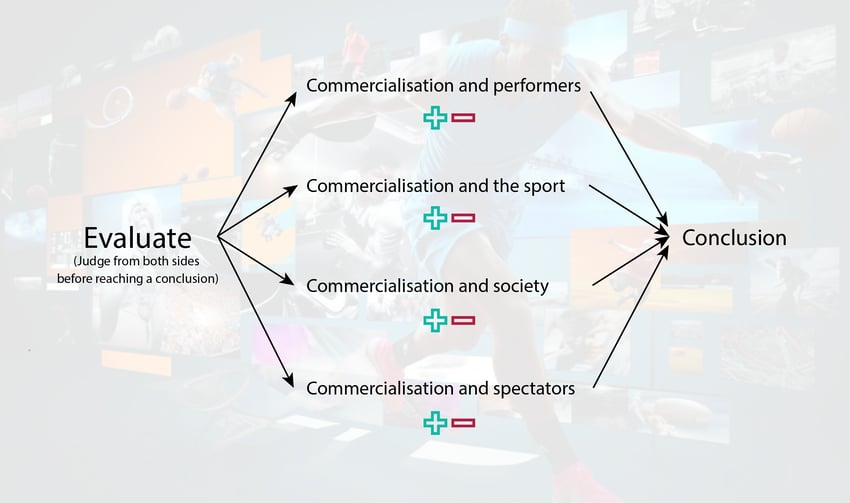
During “my two minutes”, I will seek clarification from the group and ensure that they can link this structure to what they have read in the article. My hope is that this format will become intuitive to the students and that they can identify this skill being used in the moments to follow.
Activity 3: Agreement-circles activity based on the reading
At this point in the lesson, tables are pushed to the side of the room, or we might move into the sports hall, corridor or equivalent, but the key shift is that we go from reading evaluations and being aware of what evaluating is to actually behaving evaluatively. This is essential. Students must experience evaluation in their own minds because they have to behave evaluatively.For this purpose, I would likely use an agreement-circles activity, but I might also use a folded-lines structure. You can study these methods in The PE Teacher Academy. Please visit The Academy and find the courses on Questioning Techniques. Remember that you can now also be certified on those courses (read here for more information on PE CPD certification).
I have written extensively on agreement circles in the blog in the past (blog available here), so I will keep it relatively brief, but the agreement-circles activity forces my OCR A-level PE students (or yours in your course) to behave evaluatively. They have to listen to statements that I make, choose whether they broadly agree or disagree and then step into a circle if they agree and out of it if they disagree. They then need to jot down their main ideas on a whiteboard and be prepared to debate them with other group members.
Activity 4: Idea collation phase
But rather than write about the nuances of agreement circles again (please do go and read about the nuances here), I want to draw your attention to a really subtle element of the activity: each time a statement is made and the students ponder and debate it, their main ideas must –and I really do stress MUST– be noted down on a central whiteboard that might look something like this: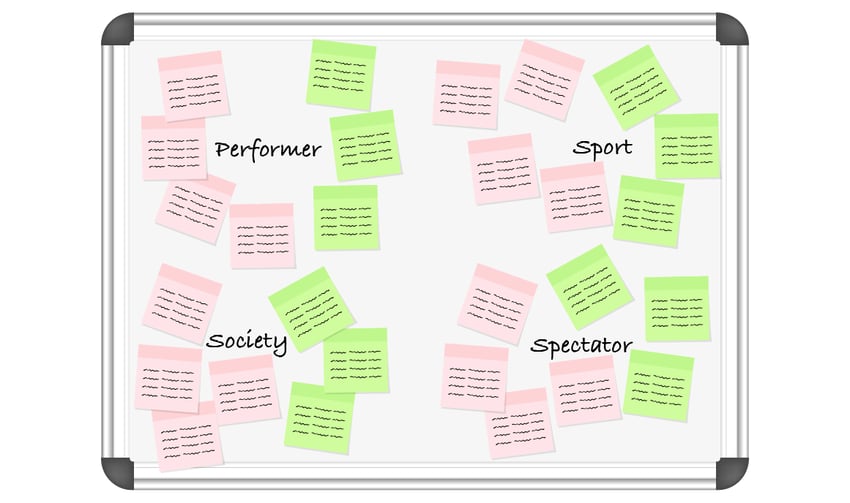
This repository of ideas that, later, the students will take photos of and add to their documentation, collates together all the key ideas of the students. It becomes a key asset to them when they begin to write evaluatively later on.
Activity 4: Extended writing - “I do”
This is a very important moment. It is so tempting to give the students some exam questions to do and let them get on with it. You may well do exactly that, but I want to challenge that assumption a little.Let’s assume that this is the first time that my students experience the extended-writing challenge in the course with the ‘Evaluate’ command. Rather than me handing the task over to them, I want them to see how an expert would go about planning an extended answer. Let’s say the question was this one:
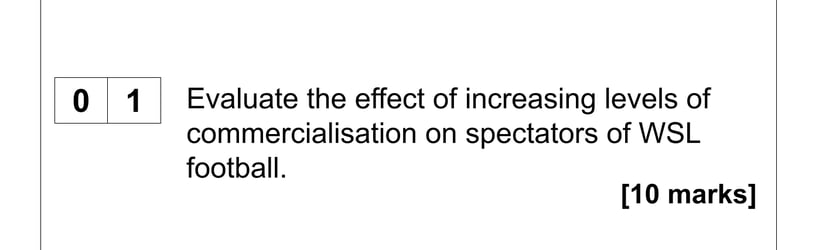
I would spend the next 10 minutes with the students observing me plan my answer. Now, I should be clear, I am not going to write the answer. Rather, I am going to demonstrate, specifically, how an expert would plan their answer. Amongst other things, I would cover:
| Highlighting the command word. |
| Highlighting the word “spectators” and making a note: “Write specifically about the positive and negative impact on spectators. They could be in the stadium or following on TV or radio.” |
| Highlighting the context/application. |
| Planning my structure: |
| Paragraph 1: Positive effects on spectators, containing phrases like: “A strength is” “A positive is” “On the plus side” |
| Paragraph 2: Negative effects on spectators “A weakness is” “A negative is” “On the downside” |
| Paragraph 3: Conclusion - probably a prediction of the future of WSL football spectatorship. |
| Plan an outline for paragraph 1: |
| State what commercialisation is. |
| State how commercialisation has developed in WSL football for the last ten years |
| Write a series of positive impacts of commercialisation on spectators, specifically in WSL. |
| Finish with a provocative statement such as “But the picture is not all rosy. Commercialisation brings some negative impacts to spectators of the WSL, too.” This can “set up” paragraph 2. |
| Write a draft conclusion, so that I know what I am “writing towards”: |
| “It is clear that commercialisation has had a varied effect on supporters of WSL football in the last decade. It is my opinion that fans attend WSL matches, watch on TV or tune in on the radio, specifically because of the family-friendly and positive nature of crowds and of the players’ approach to the sport. Commercialisation can bring an overbearing profit motive, and I encourage the owners, coaches and players of WSL to acknowledge that their USP is a sportsperson-like approach to the sport of football and to honour the spectators by preserving this ethos and not simply chasing money in the future.” |
At this point, the “I-do” stage is over. The next step is the “We-do” stage.
Activity 4: Extended writing - “We do”
Place a different (but similar) question on the board. Maybe something like: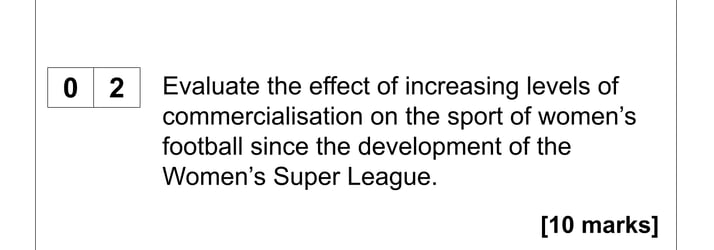
But this time, have the students guide you on what to plan. The students must perform this collaboratively, and it must become “their structure”.
Activity 5: Extended writing - “You do”
I’m sure you know what is coming here. The students now individually plan the structure of an answer to a third question. Let’s imagine that the third question is: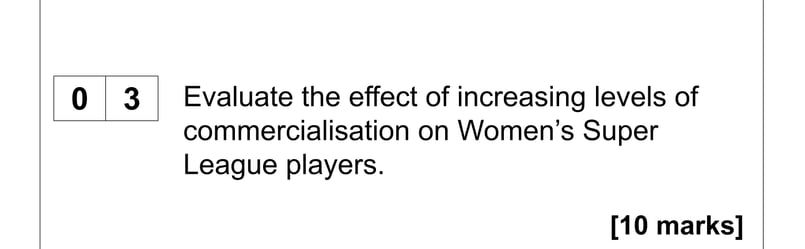
Responsibility is in the hands of the students at this point, but they are resourced and knowledgeable about how to plan an answer.
Once they plan the answer, it is a good idea that they actually answer the question, but you might want to consider them answering any of the three that have been planned to date.
A note on metacognition
“I do, we do, you do” is a classic metacognition structure. Students observe how an expert would plan an answer. Notice: they are not given the answer. This task is still for them. But the metacognitive structure is implicit to this activity. Sometimes, it is tempting to think about activities like “I do, we do, you do” as time-consuming, and they are often easy to skip. DON’T! There is little –if anything– more impactful that a PE teacher can do to support their PE students.
Activity 6: Homework - Write up the extended writing plan.
Hopefully, this can start in the classroom, but the students can definitely take some extended-writing tasks home with them to write before the next lesson. As a general guide, I tend not to ask the students to perform the hardest tasks away from the classroom, as I prefer them to do so with support available. However, because of the nature of the lesson described above, I do feel comfortable asking the students to write their answers in their own time. They have a reliable plan, a set of rendered strengths and weaknesses about commercialisation, a highly relevant article that they have read and also experiences of behaving evaluatively in the class during the agreement circles activity. Therefore, I am comfortable that they are equipped to write and to do so with probable success.It will be important how their answers are processed and improved within the next lesson, but this is a conversation for another day and another blog post.
Conclusions
Topics like commercialisation, technology, media and sponsorship are only “dry” if we teach them in a non-evaluate-skill framework. If we use the types of experiences I have detailed above, not only will students enjoy their learning of these topics more, but they will also develop key examination and life skills implicitly through the experiences. Finally, our PE students will grow from the greatest achievement of all: the development of metacognitive strategies that they can use time and time again to help them improve their performance in their PE course, their studies in general and, who knows, their life.Thanks for reading!
James