%20Text%20(Violet).png)
This summer, our 2026 revision series - live revision shows, infographics, Hot Topics, National Mock Exams, teacher and student notes - is built and ready for your students. CUB is the metacognitive thread that runs through all of it: the routine we'll model in every live session and embed in every piece of exam practice.
As we head into exam season…
As we move towards the 2026 exam window, many of us are about to step into that familiar phase of “all‑in” revision. Students are tired, you are tired, and everyone is trying to squeeze a bit more performance out of the same brains in the same PE classrooms. In that environment, the way students approach questions becomes just as important as what they know.Here’s the thing: most PE and sport students still dive straight into writing, highlight half the page, or skim past the command word and hope for the best. We see it in mock scripts, in live exams, and even in our revision lessons. This summer, I’m asking colleagues to unify around one simple, shared routine that cuts through that chaos: CUB.
The pressures on you and your students
For colleagues, the pressure is relentless: multiple exam boards, limited curriculum time, SLT expectations about grades and a revision season that seems to arrive earlier every year. You might already be integrating The Roadmap, E‑I‑O, and other exam‑technique tools but still feel that, in the heat of the exam, students revert to old habits.For students, the pressures show up differently. They panic‑highlight whole questions, latch onto a single familiar word (say, “training”) and ignore the constraint (“for a netball goal shooter”), or they write everything they know about a topic without actually answering what’s in front of them. Many of them have never been given a single, repeatable way to think before they write; they’ve just been told to “read the question carefully” and somehow make that actionable.
Let's be clear: I’ve resisted heavy annotation routines myself, especially in my YouTube revision sessions, where students join a few days before an exam. I worried that introducing a new technique too late would cause more confusion than benefit. CUB is my answer to that problem: it’s so simple, so quick, and so universal that students can pick it up in minutes and then rely on it in every revision lesson and every paper they sit.
CUB: the non‑negotiable summer exam question routine
The EverLearner's revision ecosystem is built on two pillars: content mastery (infographics, Hot Topics, live shows, notes) and exam technique foundations (PE Exam Technique - Powered by The Roadmap). CUB is the front door to both. It's the 30‑second routine that ensures your students engage with the right content AND deploy the right exam skill before they write a single word.I want to make a very clear statement: CUB should happen on every single PE and sport exam question this summer before a pen touches the answer. Whilst I acknowledge some students and teachers may opt out of the method for multiple-choice questions, I choose to set the standard of applying it to EVERY question.
At its core, CUB is one metacognitive routine with three non‑negotiables.
1. C = Circle the command word (and translate it)
- Students circle the command word only - never anything else at this stage.
- Above it, they write a short Roadmap‑style translation in student language, such as:
Analyse → “Break into parts and explain”
Evaluate → “Judge both sides, then conclude”
Explain → “Say why or how, using because/this means”
Outline → “Main details, short points”
Define/Identify/State → “Give the meaning / name it”. - We insist that translation is written, not just thought, so that the demand of the question is visible on the page.
- Students underline the topic (e.g. “principles of training”, “autonomous stage of learning”) and any constraint (e.g. “hammer thrower”, “women and girls”, “effective”, “three”).
- The key rule here is to underline both topic and constraint if a constraint is present – students are not allowed to underline just the topic and drift into a generic answer.
- This anchors their thinking to the exact concept, performer or group the exam board wants them to write about.
- Students draw a box around the mark total and write a 3–5 word plan that tells them how many ideas and how much depth the question requires.
- The standard planning might be quite simple:
1–2 marks → “1–2 short points only”
3 marks with examples → “3 separate points with three different examples”
4–5 marks → “2–3 points with because”
6–8 marks → “3–4 short paragraphs”
9–15 marks → “4–6 paragraphs with a conclusion”.
What CUB looks like on real exam questions
To make this genuinely usable, let's walk through how CUB combines with The Roadmap and E‑I‑O on the kinds of questions your students will actually see.Example 1: Analyse, high marks, performance impact
Question: Analyse the roles that the principles of training have in ensuring that a training programme is effective for a hammer thrower. (15)
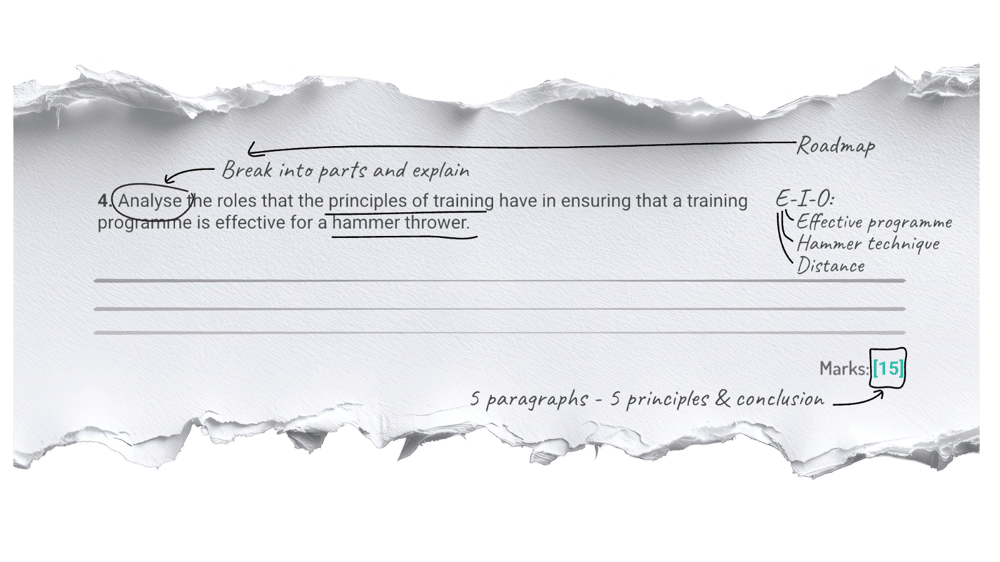
✅ Circle: Students circle “Analyse” and write “Break into parts and explain” above it.
✅ Underline: They underline “principles of training”, and “hammer thrower”. Topic and constraint are both captured.
✅ Box: They box “(15)” and write “5 roads = 5 principles” as their plan.
✅ Roadmap cue: In the margin, they note 5 obs, reminding themselves to make five clear observations that they then explain.
✅ E‑I‑O: They add E‑I‑O next to the box because this is an applied, performance‑focused question with real consequences (“effective programme”, hammer technique, distance).
When they write, each paragraph becomes a “road” from the Roadmap: one principle per paragraph, each taken through Example → Impact → Outcome for the hammer thrower. They’re no longer just listing principles; they’re analysing what each one does to the performer’s training and performance.
Example 2: Discuss, participation, targeted group
Question: Discuss strategies to increase participation in sport by women and girls. (8)
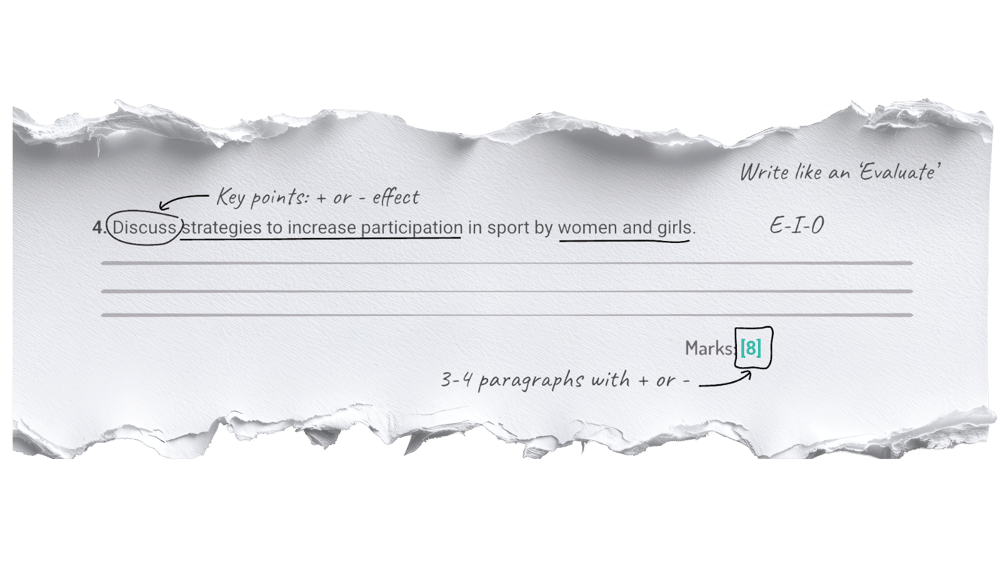
✅ Circle: They circle “Discuss” and translate it as “Key points, maybe evaluate”.
✅ Underline: They underline “strategies”, “increase participation”, and “women and girls” to lock in the focus on that group and that outcome.
✅ Box: They box “(8)” and write “3–4 roads, + / –”.
✅ Roadmap cue: In the margin, they write use Evaluate to remind themselves that Discuss here is really asking them to weigh strategies, not simply list them.
✅ E‑I‑O: They again add E‑I‑O, because the question is clearly about changing participation outcomes for a specific group.
In practice, this might look like three paragraphs each proposing a strategy, with applied examples (E), explained impact on behaviour or access (I), and the likely participation outcome (O) for women and girls. The mark scheme’s requirements for developed, applied points are built in from the start.
Example 3: Outline, pure recall, low marks
Question: Outline three characteristics of a performer in the autonomous stage of learning. (3)
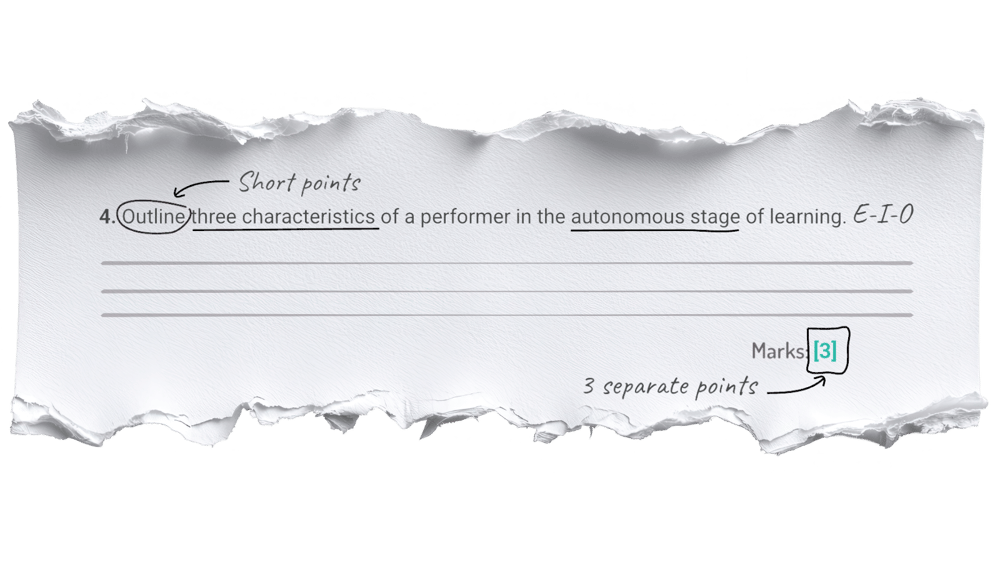
✅ Circle: They circle “Outline” and jot “Main details, short points”.
✅ Underline: They underline “three characteristics” and “autonomous stage of learning”.
✅ Box: They box “(3)” and write “3 separate points”.
✅ No extra Roadmap or E‑I‑O cue is needed; this is a straightforward recall question.
Here, CUB protects against a surprisingly common mistake – the student who writes one very detailed description and doesn’t quite make it to three clear characteristics. The plan “3 separate points” keeps the structure honest.
Across all of these, the pattern is the same. CUB is the outer shell: Circle, Underline, Box. Inside that, Roadmap tells them how to think (Analyse, Evaluate, Explain, Compare), and E‑I‑O tells them how to apply ideas to real performers, movements and participation outcomes.
Doing CUB properly this half‑term
If a department really leans into CUB between now and the exams, we should see changes in three places.1. On student scripts
- Every exam‑style question begins with visible CUB annotations: circle on the command word only, underline on topic and constraints, and box around the marks with a short written plan.
- Higher‑order questions show margin cues like 5 obs, + / – / conclusion, or use “Compare”, and applied questions show E‑I‑O by the box.
- Over time, scripts become more structured: roads are clearer, command‑word demands are met more consistently, and there are fewer generic “dump everything I know” answers.
- Teachers model CUB every time a question is projected or printed.
- In the I do phase, you annotate a question live, narrating your thinking (“I’m circling ‘Evaluate’ because that tells me I must judge both sides before I conclude…”).
- In the We do phase, you and the class annotate together: students suggest what to underline, where the constraints are, and how many “roads” the marks allow.
- In the You do phase, students annotate silently while you circulate, checking that the three non‑negotiables are present before they start writing.
- CUB becomes a shared shorthand: colleagues talk about “tightening the Underline step” or “getting Year 11 to plan their roads properly on 9‑markers” rather than vague “exam technique”.
- You can use CUB as the spine of in‑meeting training: show anonymised scripts without CUB, then scripts with CUB, and ask colleagues to spot differences in focus, structure and application.
- Over time, CUB can even act as a bridge beyond PE; the routine is deliberately generic enough to be used in other subjects while still honouring Roadmap and E‑I‑O in our domain.
A simple way to make this explicit with students is a small table you can sketch on the board.
| Without CUB | With CUB |
| Student dives straight into writing, hoping they’ve guessed what “Discuss” really means. | Student circles “Discuss”, writes “Key points, maybe evaluate”, and plans 3–4 roads with + / –. |
| Topic is noticed, constraint (e.g. “women and girls”) is forgotten; answer becomes generic. | Topic and constraint are both underlined; every example is anchored to the specific group. |
| One long paragraph that mixes three ideas with limited application. | Clear, planned roads; each idea is developed and, where needed, taken through E‑I‑O. |
Now, I am not claiming that CUB is a magic bullet. Students still need knowledge, practice and feedback. But I fundamentally reject the idea that we leave their question‑approach to chance when we can give them a three‑step routine like this.
How to roll CUB out before the summer term
Given the time pressure between now and May, we need to be realistic about what you can implement.🔥 Quick win this week
Pick one class and one paper this week and make a deal with them – every question they answer in that lesson starts with CUB. Model it once, practise it together once, then insist on “You do” before any writing begins.
⤴️ Medium‑term shift this term
As a department, agree that all PE and sport revision sessions will use CUB as a non‑negotiable routine. That might mean adding 3–4 minutes at the start of each session to annotate two questions together before students attempt them. It will feel slow at first, but you’re investing in a metacognitive habit that students can carry into every exam they sit.
📈 Long‑term transformation beyond 2026
Beyond this summer, the goal is that CUB is embedded from early in the course, not bolted on at the end. Year 10s and Year 12s can learn CUB alongside The Roadmap and E‑I‑O, so that by the time they hit their final exams, annotation is automatic and mental bandwidth is freed for genuine analysis, evaluation and application.
Colleagues sometimes worry that students can’t learn a new routine this close to exams. My view is that students cannot afford not to learn this one; it’s simple, it’s consistent, and it aligns directly with how mark schemes reward structured, applied answers.
Conclusions
Download and share the free CUB teacher and student guide with your department. If you want CUB modelled live for your students this summer, our 2026 live revision shows run from April and are included in every EverLearner subscription. And if you'd like the complete exam‑technique foundation - command words, paper processing, answer structuring - PE Exam Technique, Powered by The Roadmap, is available now for Gold‑tier subscribers.Teaching and revision are complex, and there is never a single right way to prepare students for exams, but I am convinced that a unified, reliable routine like CUB can make this summer’s PE and sport exams calmer, more focused and more successful for your students. When I commit something like this to a single acronym, I always feel a little nervous because it means I’m inviting you to adopt it in your real classrooms, not just as an idea on a blog.
Thank you for reading. I’d be grateful if you downloaded and shared the free CUB teacher and student guide with your department, and considered making CUB a non‑negotiable routine in your revision sessions this summer. Have a lovely week and a settled revision season.
James