The short version: to find the GCSE and A-level PE marks that most separate students, read your course’s examiners’ reports side by side, note the skills and topics that come up year after year, and label each as knowledge or skill. Then give those areas extra retrieval, modelling and feedback, while still teaching everything. James calls these marks 6-pointers.
Dear PE colleagues,
Let me start with football. Picture the last few weeks of a season. The two teams at the top of the league meet, and every pundit calls it a “six-pointer”. Why six, when a win is only worth three? Because the winner takes three points and stops their rival taking three. The gap between the two outcomes is six points. Six.
Here’s the thing: our exams work in a very similar way.
Grades aren’t awarded in a vacuum. Grade boundaries are set against the performance of the whole national cohort. So when most students drop marks on a particular skill or topic, the boundaries reflect that. And if your students win those marks, they don’t just add to their own total. They pull away from the students they are being measured against, in exactly the places where those students fall short.
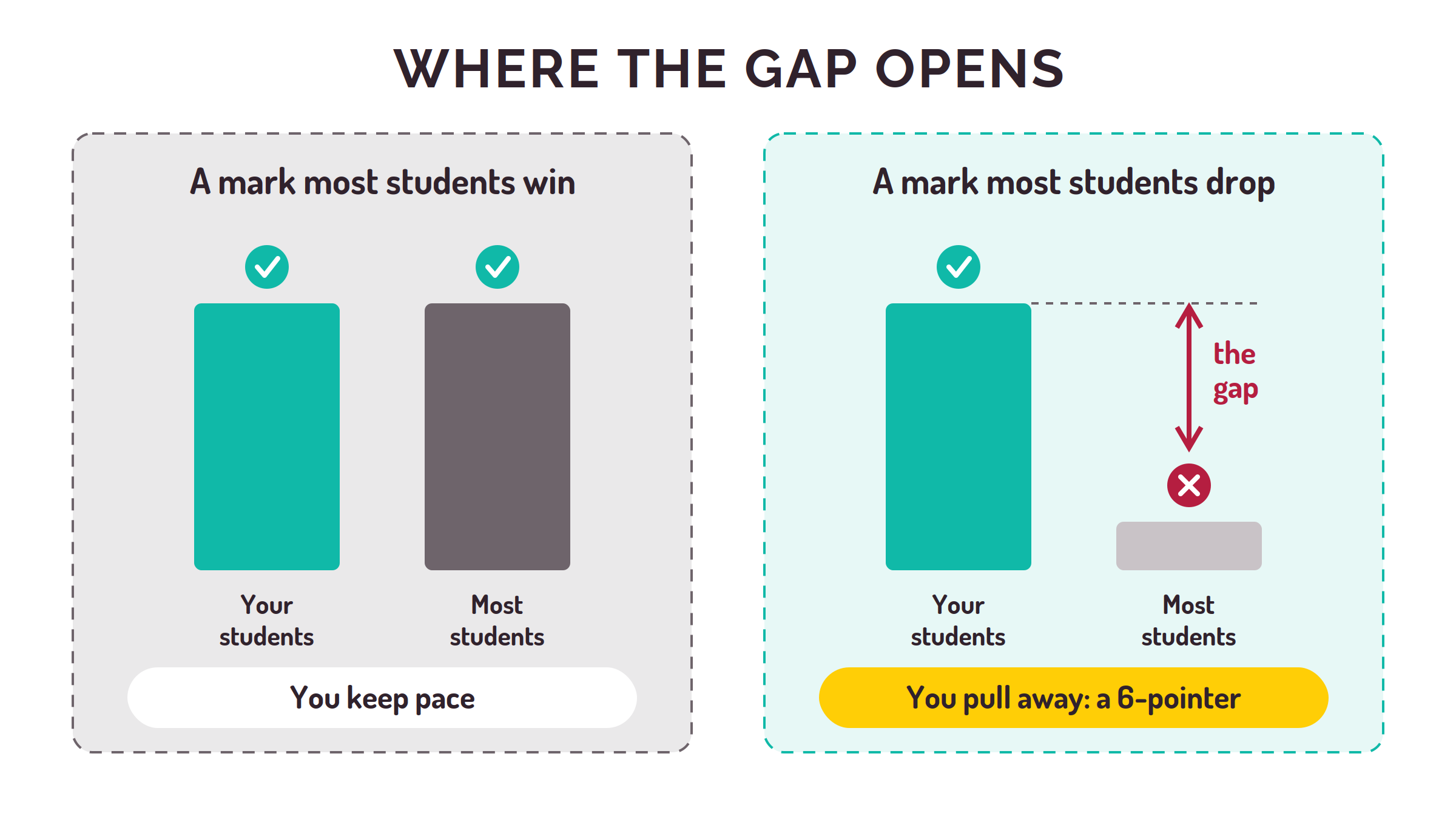
That’s the 6-point Effect. Some marks are worth more than others: not on the mark scheme, but in the competition every cohort is in, whether we like that word or not.
In this post I want to show you how I find those marks, share five examples from five different courses, and suggest how you might build your own hyper-focus without neglecting anything else.
Should every PE topic get equal teaching time?
Let’s be candid. Early in my career, I turned up and gave equal importance to everything. Every topic got the same time, the same approach, the same type of lesson, the same type of homework. It felt fair. It felt thorough. It felt like good teaching.
I was wrong.
Not wrong to teach everything. That part was right, and it still is. I was wrong to weight everything the same. I treated a topic that almost every student in the country handles well exactly as I treated a topic that students have struggled with year after year. My students learned plenty, but I hadn’t asked the most strategic question available to me: where, nationally, do students lose marks?
These days, I’m very strategic. Let me be clear about what that means and what it doesn’t. Nothing gets ignored. Every specification point is taught, practised and revisited. But a hyper-focus forms around certain skills and areas, because the evidence tells us that this is where other students struggle. That’s where my extra minutes go: the extra retrieval, the extra modelling, the extra feedback.
“
Nothing gets ignored. But a hyper-focus forms where others struggle.
If you’ve always given everything equal weight, please don’t read this as criticism. It’s what most of us were trained to do, and it comes from a good place. I’m simply suggesting there’s a sharper way.
How do you find where PE students lose marks?
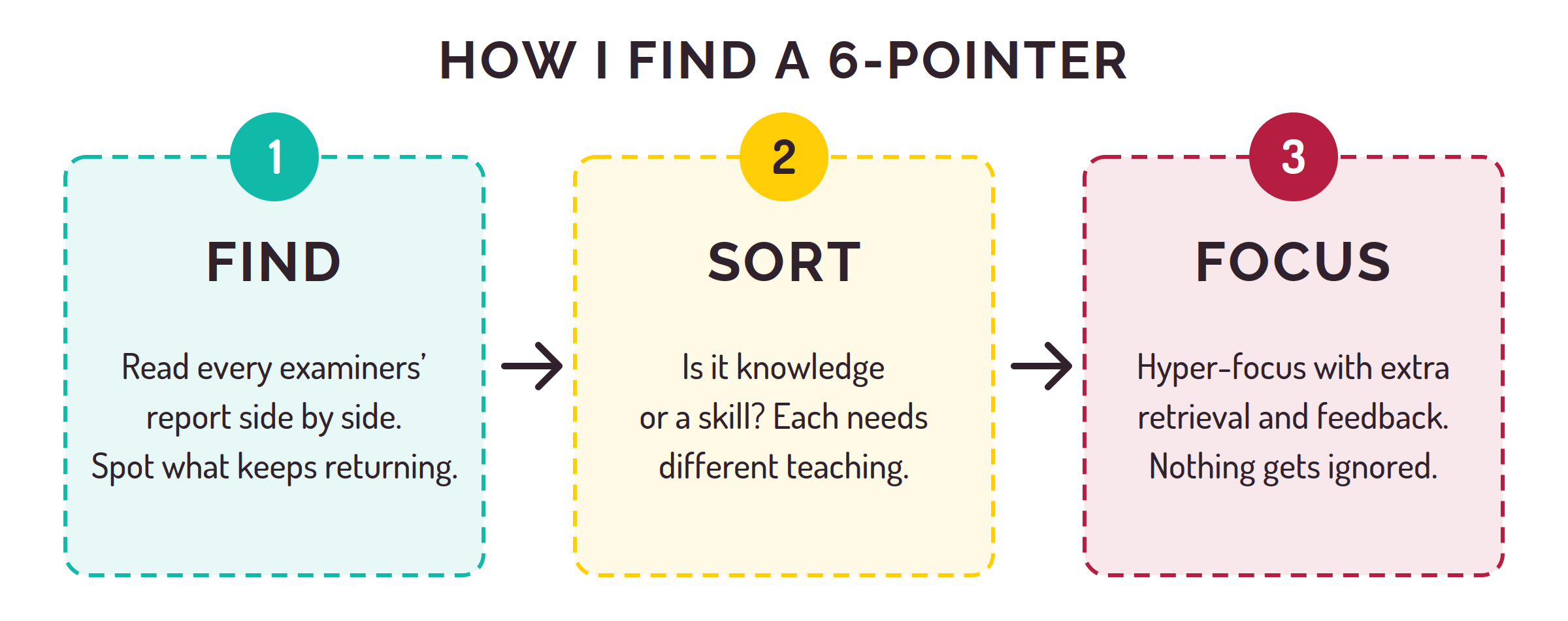
Step 1: Read the examiners’ reports across the years
What: Line up every published examiners’ report for your course and look for the comments that come back again and again.
Why: A single report tells you about one paper. Several reports side by side tell you about a pattern. A weakness that shows up in 2018, 2019, 2022, 2023, 2024 and 2025 isn’t bad luck on one question. It’s a gap in how students across the country are being prepared.
How: For each recurring comment, note the topic or skill, the years it appears and what students do wrong. You’ll usually find a handful of themes that never go away.
Example: You’ll see one in a moment: a contraction type that AQA GCSE students have been getting wrong since the first series of the specification.
Step 2: Separate knowledge gaps from skill gaps
What: Some 6-pointers are knowledge gaps (a confused definition, two similar terms swapped). Others are skill gaps (students know the content but can’t justify, analyse or evaluate with it).
Why: They need different teaching. A knowledge 6-pointer is often fixed with precise teaching and frequent retrieval. A skill 6-pointer needs modelling, deliberate practice and feedback on how students answer, not just what they know.
How: Label each theme K or S. Be honest: many of the most valuable 6-pointers are skills.
Example: OCR GCSE students can usually place a skill on a continuum (knowledge). Justifying the placement (a skill) is where marks disappear.
Step 3: Focus hard without neglecting anything
What: Give your 6-pointers more exposures, more retrieval and more feedback than other topics, while still teaching everything.
Why: This is a biggy. If we drop topics to chase “valuable” marks, we’re gambling, and I fundamentally reject that. We never predict exam papers. We use patterns to decide where our emphasis goes, never what we leave out.
How: Build each 6-pointer into your spaced retrieval calendar several times across the course, rather than teaching it once and hoping.
Example: A 6-pointer might appear in a low-stakes quiz every three or four weeks across two years. A topic students nationally handle well might appear every term.
Five 6-pointers from five courses
These come from the published examiners’ reports for each course. The practice questions are my own, written in the style of each board.
Why do AQA GCSE PE students confuse concentric and eccentric contractions?
What: Identifying whether a muscle is contracting concentrically or eccentrically during a sporting action.
Why: This has been weak in every AQA GCSE PE examiners’ report since 2018. In one year, fewer than one in five students got it right, and many left it blank. Students often give the opposite type to the correct one, which tells me they’ve memorised two words without a way of telling them apart.
How: Give students one question to ask every time: “Is the working muscle getting shorter or longer while it works?” Then add a second check for downward movements controlled against gravity, which are often eccentric. For the wider picture on muscle and joint content, see my post on teaching the musculoskeletal system for AQA, Edexcel and OCR GCSE PE.
TRY THIS · AQA GCSE PE
A basketball player lands from a jump shot and bends at the knees to absorb the landing. Identify the type of contraction occurring in the quadriceps during the landing. (1 mark)
What a strong answer does: says eccentric, and can tell you why: the quadriceps lengthen while working to control the knee bending.
What language do Edexcel GCSE PE students need for movement analysis?
What: Using precise technical language when analysing movement: muscles contract and relax; joints flex and extend.
Why: Edexcel’s Paper 1 reports have raised this in every series since 2018. Students write that a muscle “flexes”, call an agonist “relaxing”, name only one muscle of the pair, or abbreviate names. They often understand the movement perfectly well. The language lets them down.
How: Teach a fixed sentence frame and insist on it: “At the [joint], [flexion/extension] occurs. The [agonist] contracts and the [antagonist] relaxes.” No shortcuts, no “quads”, no “hams”. Precise joint actions are the foundation here. For how I teach the movements around them, see my posts on teaching planes and teaching axes.
TRY THIS · EDEXCEL GCSE PE
Analyse the movement at the knee during the upward phase of a squat jump. (3 marks)
What a strong answer does: names extension at the knee, the quadriceps contracting as the agonist and the hamstrings relaxing as the antagonist. Three clear, technical points.
How do OCR GCSE PE students justify a skill classification?
What: Explaining why a skill sits where it does on a continuum.
Why: OCR’s reports show students place skills on continua well. Justifying the placement is where they struggle, and it was rated weak in 2025. Answers such as “it’s closed because it’s just one movement” or “it needs lots of practice” earn nothing.
How: Give students the reasons each continuum is built on: decisions and information processing for simple to complex, sub-routines for low to high organisation, and whether the environment affects the skill for open to closed. Then make them use those words every time.
TRY THIS · OCR GCSE PE
Classify a vault in gymnastics on the open–closed continuum. Justify your answer. (2 marks)
What a strong answer does: says closed, because the environment is stable and doesn’t affect the performer, so the vault can be performed the same way each time.
How do AQA A-level PE students answer analyse and evaluate questions?
What: The three- and four-mark questions that test AO3, where students must analyse (link a point to its impact) or evaluate (reach a judgement).
Why: AQA’s A-level reports have named these the main weakness on both papers in every series from 2022 to 2026. Students write accurate knowledge that simply isn’t what the question rewards. AO1 knowledge on its own earns nothing in these questions.
How: Model the chain: point → how it works → impact on this performer. Then make students annotate their own answers to show where each link is.
TRY THIS · AQA A-LEVEL PE
Analyse how mental practice could improve the performance of a high jumper. (3 marks)
What a strong answer does: a weaker answer explains what mental practice is. A stronger one says that rehearsing the run-up and take-off in the mind strengthens the motor programme, so the take-off is more consistent in competition and the jumper is more likely to clear the bar.
How do OCR A-level PE students tell cognitive from somatic techniques?
What: Telling cognitive stress management techniques apart from somatic ones.
Why: OCR’s reports from 2023, 2024 and 2025 show students mixing them up in both directions: cognitive techniques given when somatic ones are asked for, and vice versa. The specification names the techniques, so these are marks that should be secure.
How: One question sorts it: “Does this technique work on the mind (thoughts and worries) or the body (tension and physical symptoms)?” Mind is cognitive, body is somatic.
TRY THIS · OCR A-LEVEL PE
Identify two somatic stress management techniques a rugby goal kicker could use before a kick. (2 marks)
What a strong answer does: gives progressive muscle relaxation and centring (or breathing control, or biofeedback), not imagery or positive self-talk.
Your 6-pointer planner for GCSE and A-level PE
This is simple enough to sketch on a whiteboard in a department meeting:
| Course | 6-pointer | Why marks go | What my students do instead |
|---|---|---|---|
| AQA GCSE PE | Concentric or eccentric | Two terms memorised with no way to tell them apart | Ask “shorter or longer while working?” |
| Edexcel GCSE PE | Movement analysis language | Muscles “flex”; one muscle of the pair; abbreviations | Fixed sentence frame, full names |
| OCR GCSE PE | Justifying classification | Placement without the reason | Use the continuum’s own criteria |
| AQA A-level PE | Short-answer AO3 | Knowledge without impact or judgement | Point → how → impact on this performer |
| OCR A-level PE | Cognitive or somatic | Techniques swapped | Ask “mind or body?” |
Add a row for each theme you find for your own course. Five or six rows are plenty to start.
Why do retrieval, spacing and interleaving help?
Three principles from the research do most of the work here. Retrieval practice strengthens memory each time students pull something back out of their heads, so 6-pointers belong in your low-stakes quizzes again and again. Spacing means those quizzes are spread across months, not crammed before the mock. And interleaving, mixing similar items that students confuse, is perfect for many 6-pointers: put concentric and eccentric examples side by side, or cognitive and somatic techniques in the same quiz, so students have to tell them apart rather than recognise them.
There’s a fourth, quieter one: metacognition. When students check their own justification or label the links in their own analysis, they learn to monitor the very skill the national cohort finds hardest.
Getting started
Quick win (this week): Pick one 6-pointer from the list above that matches your course. Put two questions on it in your next retrieval quiz and see what happens. You may be surprised how many of your students fall into the same trap as the national cohort.
Medium-term (this term): Read the examiners’ reports for your course side by side and build your own planner of five or six 6-pointers. Schedule each into your spaced retrieval calendar at least once every few weeks.
Long-term (this year): Make the 6-pointers a department habit. Share the planner, agree a common approach to each one (the same sentence frame, the same question to ask) and revisit the list every year once the new reports are published.
Common questions
“Isn’t this just teaching to the test?” I don’t think so. Teaching to the test means narrowing what we teach. This does the opposite: we teach everything, and we add depth where students most need it. Every 6-pointer above is a genuine skill or genuine understanding, not a trick.
“I don’t have time to read eight years of examiners’ reports.” I completely understand, and you’re not on your own. I know how manic life can be as a PE teacher, especially from now until the summer. That’s exactly why I’d love you to join us at the network meeting below.
JOIN US · FREE
AQA GCSE PE Paper 1: Where the Marks Are Won
Tuesday 24 November, 16:00 (UK time) · Online · Free to attend
We’re bringing AQA GCSE PE teachers together to do exactly what this post describes, in much more depth. We’ll identify the 6-pointer zones for AQA GCSE PE Paper 1 and share practical strategies for lifting your cohort on each one. It’s a network meeting, so you’ll hear from colleagues as well as from us. Paper 2 will get its own meeting next.
This is a customer event, and you’re welcome to bring one colleague from another school who doesn’t yet use TheEverLearner.com. Add their details when you register. Places are limited, so register soon.
If you teach a different course, let us know. We’d love to run these for other courses too.
The six-pointer is the match everyone remembers at the end of a season. The marks most students drop are our six-pointers, and when our students win them, they don’t just gain. They pull away.
I urge colleagues to find their first 6-pointer this week. Start small, gather your own evidence and see what it does for your students.
Thank you for reading. I’d be grateful to hear which 6-pointers you’ve spotted in your own course, and whether you agree with mine.
Have a wonderful week.
James