%20Text%20(Violet).png)
Hi, I'm Hannah. I'm a PE teacher here at The EverLearner. I know James usually writes these posts, but this week it's my turn. When asked, I nearly said no, not because I don't have things to say (I do!), but because writing about teaching feels a lot more exposing than actually doing it. So here goes, please be kind.
Firstly, I have to admit that I never really thought much about how I taught or why the activities I used would help my students retain or apply the information. I just did things because they either worked or I liked doing them. It wasn't until I joined The EverLearner, chatting week in week out about cognitive science, having the opportunity to meet and deliver CPD to PE teachers across the UK and internationally, and then delivering the live revision shows, that I really thought carefully about what and how we were actually teaching. Honestly, this job gave me the time and space to be able to do that. I realised early on, we weren't just delivering content, we were teaching students how to think and, hopefully, teachers how to make their own students think. Actually, not just how to think, but how to approach a question, check their own understanding, and practise in a way that actually sticks.
Ultimately, this is what metacognitive teaching means. It doesn't require a postgraduate qualification to understand it, or loads of fancy research journals. It does not need to be complicated. Metacognition is simply the process of thinking about thinking, helping students become more aware of how they learn, not just what they learn. It’s great that so many teachers are already doing it. You might, like me, just not have a name for it yet.
Let's clear something up
Metacognitive teaching is not a trend. It's not a buzzword your SLT has picked up from a CPD course (although they definitely will be throwing it around on training days!). It's not something that requires a complete overhaul of your planning. It is, effectively, teaching students how to engage with content, not just what the content is. When we teach metacognitively, we're building students who can identify when they don’t understand something, correct their own errors, and apply what they know to questions they've never seen before.
In PE theory, that matters enormously. Our students aren't just recalling facts. They're being asked to explain, analyse, justify, and evaluate. Those are thinking skills, and thinking skills need to be taught, practised, and modelled, just like any other skill.
I want this post to be for every PE teacher, whether you're in your first year of training, two years into your career, or 20 years in and quietly wondering whether your practice has become a little too comfortable. I want to walk you through nine strategies we've been using in The EverLearner's live revision shows and notes, and show you exactly what they look like in practice. These can be easily slipped into your everyday classroom teaching:
3. Interleaving prior knowledge
4. Command-word-focused teaching
5. Scaffolding through the Roadmap language
1. CUB
What is it?
CUB is a question-processing routine that students apply before they write a single word of their answer. It has three steps:
- Circle the command word and write a short plain-language translation above it ("Evaluate = judge both sides, then conclude")
-
Underline the topic and any constraint ("a hammer thrower," "women and girls," "during a game")
-
Box the mark total and write a quick three-to-five word plan that translates marks into structure
You can read the full CUB blog by James here.
Why does it work?
I believe most students don't lose marks because they don’t know the answer, but rather because they misread the question, ignore a constraint, misidentify the command word, or write two points when the mark scheme clearly needs three. CUB is a 30-second pause that stops that happening. It makes the invisible visible: students have to consciously decide what skill is being asked for, who or what the answer must be applied to, and roughly how many ideas they need. That deliberate decision-making before writing is metacognition at its most practical.
In every live revision show, we CUB every question, no exceptions. Students watching can see exactly how we process a question before we commit to answering it. That modelling is important.
Try this tomorrow:
Project an exam question onto the board and give students the same question on paper. Allow 30 seconds for everyone to CUB it independently: circle and translate the command word, underline the topic and any constraint, box the marks and write a mini plan. Then compare theirs with yours. Use the differences as a conversation: "Why did I underline that word?” “What did boxing the marks tell us about structure?" That conversation is the metacognitive teaching.`
Watch the PE team demonstrating how to apply CUB in the live revision sessions:
2. E-I-O
What is it?
E-I-O is a model for helping students go beyond surface-level answers when applying their knowledge. It stands for Example, Impact, Outcome. When a student is asked to apply their knowledge, say, explaining how agility contributes to basketball performance, E-I-O pushes them to go further than just naming an example. They must also explain the impact of that example and the outcome it produces.
Why does it work?
It helps the students to write answers with greater depth, encouraging them to structure their writing to include both the impact and outcome of the example (effectively, to keep asking "so what?" after every example they make). I find that this really helps students think in more detail and ensures they hit the AO2 and AO3 marks in every ‘Explain’ question.
Try this tomorrow:
Make students watch you highlight a model answer with the E-I-O model. Then change one slight variable about the question and ask them to write their own answer, and E-I-O highlight it. This fits perfectly into any sort of physical training question or even a diet or nutrition question. In fact, with any application-style question, students should be using the E-I-O model to help them.
This is how we have done it during the revision series:
3. Interleaving prior knowledge
What is it?
Interleaving means deliberately mixing content from different topics rather than teaching and revising one topic in one block before moving on. It helps students make connections between knowledge rather than treating every aspect as distinct content, only linked together by an exam.
Why does it work?
Research on interleaving consistently shows that it strengthens long-term retention. When students have to switch between topics, their brains have to work harder to retrieve and connect information, and that effort is what makes learning stick. It also teaches students something important about their own knowledge: they begin to notice which topics they can retrieve fluently and which ones they're still shaky on. That self-awareness is metacognition.
Try this tomorrow:
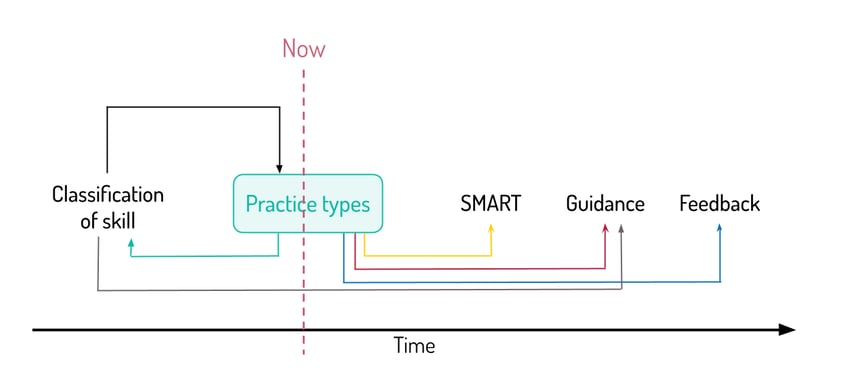
The point of interleaving is to show the interconnectedness of all knowledge and to highlight the knowledge that comes before and the knowledge that will follow on from the content you are teaching. For example, using a flow chart or schematic can perfectly map this out. Let’s look at how this would work for practice structures:
4. Command-word-focused teaching
What is it?
Command-word-focused teaching means explicitly teaching students what different command words (‘Describe’, ‘Explain’, ‘Analyse’, ‘Evaluate’, ‘Justify’, etc.) actually require them to do. You’re not just assuming they already know this. Teach it directly, repeatedly, and in context.
Why does it work?
One of the most common reasons why students underperform in PE theory exams isn't a lack of knowledge, it's a failure to understand what the question is actually asking them to do. When we teach command words explicitly, we're teaching students to read a question metacognitively: to pause, identify the demand, and write their response accordingly. This goes hand-in-hand with CUB.
Try this tomorrow:
Take a past-paper question and its full-mark, model answer and remove the command word. Ask students to suggest what command word fits and to explain why. This reversal forces them to think about the purpose of command words, not just follow them mechanically.
OR...
Set a short exam across all the content taught so far, but only using one command word. This week it could be ‘Explain’, next week you could focus on ‘Justify’. Customers can use our data centre to help identify the key command words that repeatedly come up across the different lesson content.
One of the things I hear most from teachers is that there's never enough time to teach exam technique and content. Our Gold Subscription Package is designed with exactly that in mind. The Exam Technique course, powered by the Roadmap, builds command-word confidence across the whole course, so it never feels like a last-minute add-on.
5. Scaffolding through the Roadmap language
What is it?
This follows on perfectly from command-word-focused teaching; what makes the Roadmap different from other writing frameworks, like PEE, or PEA (!!) is that it doesn't just tell students what to write. It teaches them to understand what a question is actually asking, which is something I’m not sure I fully embraced in my earlier years of teaching. Each command word has its own Roadmap, complete with suggested language. The suggested language is my favourite bit, because it really helps students to write a well-structured answer to the question. You can access your free copy of our Roadmap here.
Why does it work?
In the live revision shows, you'll see us use Roadmap language constantly, not just in model answers, but when we CUB questions too. It’s our way of ensuring that students use all that knowledge that they know so well, and actually put it into the correct context of the question. I talk a lot about pattern building in the Edexcel revision sessions, and this is actually what it is. Using the Roadmap language as a pattern and filling in the gaps with the right knowledge.
Try this tomorrow:
Pick one command word that your current class struggles with. ‘Explain’, ‘Evaluate’, or ‘Analyse’ are usually the culprits. Display that command word's Roadmap on the board and build an answer together using the Roadmap language as your guide. Ask your students: “Which Roadmap language have you used?” and “Can you use one more Roadmap phrase to add more depth to your answer?” Over time, those check-in questions become the internal voice students use in exams, without you in the room.
Watch how we have integrated Roadmap language throughout our question answering during the Revision series:
6. Questioning techniques
What is it?
This is about the type of questions we ask, moving beyond simple recall questions ("What is a lever?") toward questions that require students to think about their thinking ("How?”, “Why?”, “What if?" or my favourite “What if not?”)
Why does it work?
When we ask students why they think something, or how this will have an impact on someone or something, we're asking them to think about their thinking. That's the heart of metacognitive teaching: helping students see their own thought processes, so they can monitor and improve them.
Try this tomorrow:
I am a big fan of some of the questioning techniques that James has talked about in the PE Teacher Academy. In fact, they are my favourite lessons. I wish I had had a chance to use them in my own GCSE PE teaching, especially when helping students to really think deeply for their AO3 type questions like ‘Evaluate’ and ‘Justify’. Two of my favourites are folded lines and agreement circles.
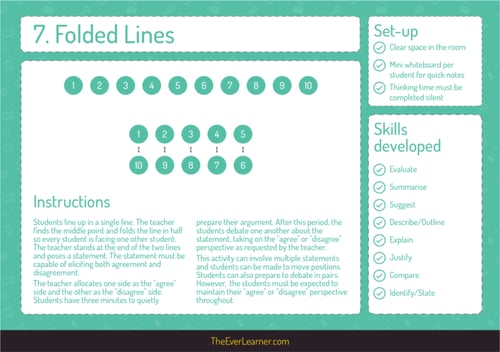
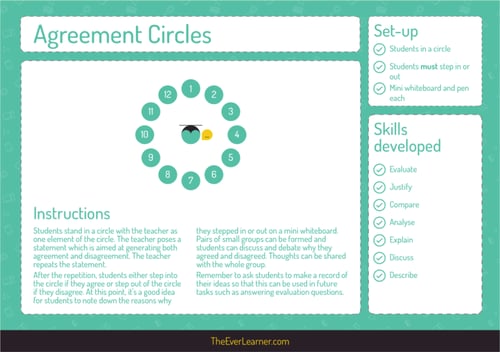
Our PE Teacher Academy has courses covering pretty much every aspect of PE theory teaching. I just wish some of them had existed earlier in my career. My personal favourites are the Questioning Techniques lessons, partly because you can watch them and walk straight into your next theory lesson with ready-made activities. But there's something for everyone: subject knowledge courses if you're teaching a topic that's new to you (the biomechanics ones would have saved me more than once), curriculum and SoW design if you're thinking about bigger structural changes, and memory and remembering courses if you want to make sure students actually keep what you teach them, not just learn it for the test, then forget it.
If any of that sounds useful, book a quick call with us and we'll show you everything.
7. I do - We do - You do
What is it?
This is a gradual release of responsibility model. The teacher models a skill or process fully first (“I do”), then works through it collaboratively with students (“We do”), before students attempt it independently (“You do”). It's one of the most researched and reliable instructional sequences in education, and I love using it!
Why does it work?
The metacognitive value here is in the “We Do” stage. When teacher and students work through something together, the teacher is making their thinking visible to the whole class - "I'm looking at this word and it's telling me...", "I must make sure I include the advantages", “Is my example specific enough?”. Students aren't just watching the answer emerge; they're watching the thinking process that produces the answer. That's a powerful model.
Try this tomorrow:
Try a full “I do - We do - You do” sequence with one exam question in your next lesson. In the “I do” stage, talk aloud through every decision you make, including the ones that feel obvious to you (don’t worry if you feel silly, I felt like this all the time while doing it!). These thought processes are often the ones students most need to hear.
If you want to see this being demoed live by James - sign up to take part in our Project Perfect PE Teaching on 24th June.
8. Model answers
What is it?
Model answers are high-quality example responses that show students what a well-constructed answer actually looks like. In the live shows, we often write or annotate model answers live, rather than just presenting a finished product.
Why does it work?
A model answer on its own is useful. A model answer that's been built in front of students, with commentary on every decision, is transformative. It’s another strategy that makes the invisible visible. Students can see why certain phrases earn marks, why structure matters, and how to move from knowing the content to expressing it effectively.
Try this tomorrow:
Rather than handing out a model answer, build one live with your class. Ask students to suggest sentences, then discuss, as a group, whether each sentence earns its place. Why? Why not? What would make it better? That discussion is metacognitive teaching at its best, and links perfectly to the “I do - We do - You do” model.
For more ideas, read this blog post: '6 ways to use model answers in your PE and Sport lessons'.
9. WAGOLL vs WABOLL
What is it?
WAGOLL stands for What A Good One Looks Like. WABOLL stands for What A Bad One Looks Like. I actually only found this out last month! But I have been using this system of contrasting good and bad answers for quite a while. Using both together gives students a contrast, not just a model to copy, but a comparison that sharpens their ability to evaluate quality in their own work, both in coursework and exam-writing.
Why does it work?
Showing students only good examples can create a vague sense of the target without giving them the tools to self-assess. When you show both a strong and a weak response, you ask students to be critics, to identify specifically what makes one better than the other. That critical evaluation is a core metacognitive skill. It builds the internal quality-checker that students need when they're sitting an exam alone.
Try this tomorrow:
Give students two responses to the same question (one strong, one weak) without labelling which is which. Ask them to identify which is better and to write three specific reasons why. Then reveal the labels. Did their reasoning match the mark scheme logic? If not, that's a great conversation to have.
Watch the following video to see how this has been shown throughout the revision series:
A challenge for every teacher
So, hand on heart, how metacognitively are you teaching right now?
I don't ask that to make you feel uncomfortable (you are 100% not having to share the answer with anyone!). I ask it because I think it's the most useful question we can ask ourselves after reading a post like this. And I think the honest answer, for most of us at some point in our careers, is: probably less than I could be. Which is fine, because the best teachers I know are the ones who never stop reviewing their own practice and have absolutely no shame about pinching great ideas from wherever they find them.
If you're a trainee or early-career teacher, it's completely natural to be focused on content right now. Getting through the lesson, covering the material, keeping the class with you, those things rightly take up most of your mental energy at this stage. But even in those early lessons, one small metacognitive move, a well-chosen question, a WAGOLL/WABOLL to compare, can make a real difference to how students engage with what you're teaching.
If you're a more experienced teacher, I want to politely ask something harder: has your teaching become a little too comfortable?
Not in a bad way, experience builds confidence, and confidence builds better lessons. But comfort can also mean habit. And habit can mean we stop asking why we do what we do. We deliver the same lessons in the same way because they work or at least, they've always seemed to, and we probably don’t have loads of time to be re-jigging everything, every year. But working and causing deep learning aren't always the same thing.
Here's the evaluate question I'd like to leave you with, because if we're teaching our students to evaluate, we should be willing to do it ourselves:
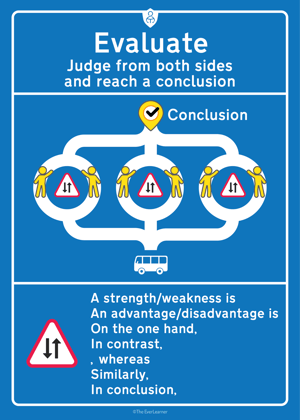
Use it. Apply it to your own practice. Weigh up the strengths of what you already do, and be honest about the gaps. What would it look like to bring even two or three of these nine strategies into your classroom more deliberately during the remainder of this term?
You don't need to overhaul everything overnight. Pick one strategy from this post that you don't currently use, or don't use intentionally, and try it this week or after half term. Just once. See what happens. Notice what your students do differently. Then notice what you do differently.
Because metacognitive teaching doesn't just change how students learn. It changes how teachers teach. And that, I think, is worth the effort.
Thank you for reading. I hope this is helpful, whether you're just starting out or well into your teaching career.
Hannah