%20Text%20(Violet).png)
As this goes live, we are halfway through our 2026 live revision series. Two shows a day, every day, for the next two weeks. Thousands of GCSE, A-level and BTEC Sport students are tuning in between mocks, training, part-time jobs and whatever else life is throwing at them. Everyone is tired. Everyone is under pressure. And in the middle of that, one routine has quietly become the anchor for how we process and answer every exam-style question on screen: CUB. Circle. Underline. Box. It is earning students extra marks right now, in the last few days before their exams, and in this post, I want to show you exactly how we are using it in the live shows and how you can pinch that for your own classroom or revision.
The pressures we are all feeling this fortnight
For students, these final days before exams are a strange mix of adrenaline and fog. They open a paper, see a six- or nine-mark question, and the temptation is to just start writing. They half notice the command word, barely register the little contextual detail about “during a game” or “women and girls”, and have no clear sense of how many separate ideas the marks are asking for. Then they are surprised when the mark scheme says “one mark for identification, two marks for explanation” and they have written a beautiful paragraph that only scores two.For teachers, the pressure looks different but feels just as heavy. There is never enough time. You are trying to cover the specification, reassure anxious classes, keep practical going where you can, and somehow still find space to teach exam technique properly. You look at mock papers and see the same patterns over and over again: students misreading command words, drifting into generic answers that ignore the constraint, stopping at two points when three are clearly needed. You know those are not really “knowledge gaps” so much as processing gaps. But in May, those gaps still cost real marks.
CUB sits right at the intersection of those pressures. It does not magically create knowledge that your students do not have. What it does do, in 30 seconds, is help them stop throwing away marks they have already earned through two years of work.
Six ways CUB is earning marks in the 2026 exams
1. CUB slows you down just enough to speed your marks up.In every live show, before a pen touches the answer, we CUB the question. Always. Circle the command word. Underline the topic and any constraint. Box the marks and write a three- to five-word plan. That 30-second pause feels slow to students at first, especially when they are nervous. It is exactly that pause that removes the detour into the wrong skill, the wrong topic or the wrong depth. They are not losing time to CUB, but buying themselves more marks per minute. If you watch the clips from this week’s shows, you will see this pattern clearly because we refuse to write an answer until the C, the U and the B are all visible on the page.
Clips from this week’s PE and Sport revision shows
2. Circle the command word or you are guessing the skill.
Students circle the command word only. Nothing else. Above that circled word, we always write a short translation in plain language, such as “Analyse = Break into parts and explain”, “Evaluate = Judge both sides, then conclude”, or “Outline = Main details, short points”. That written translation is non-negotiable. It forces the learner to make a conscious decision about the skill before they decide what to write. In the live shows, we narrate this out loud: “I am circling ‘Analyse’ because this tells me I must break this into separate observations and explain each one.” If you show that clip to your class, pause when the circle appears and ask them, “What would you write above this?”
3. Underline the topic and the constraint to block generic answers.
Next, we underline the topic and, crucially, any constraint. Topic might be “principles of training” or “autonomous stage of learning”. Constraint might be “a hammer thrower”, “women and girls”, “during a game” or “effective training programme”. The rule we insist on in the shows and in the teacher guide is simple: If a constraint is present, both topic and constraint must be underlined. Students are not allowed to underline just the topic and drift into a generic answer about “training” or “motivation in sport”. When you watch the annotated examples, listen for the moment where we say something like, “I am underlining hammer thrower because this answer has to be about hammer, not just training in general.” That underlining on its own saves marks that would otherwise be lost to vague, non-applied responses.
4. Box the marks and make a three- to five-word plan.
Then we deal with the marks. Students draw a box around the mark total at the end of the question. Next to that box, we write a tiny plan that translates marks into structure. The default planning rule looks like this.
- 1 to 2 marks: “1–2 short points only”.
- 3 marks: “3 separate points”.
- 4 to 5 marks: “2–3 points with because”.
- 6 to 8 marks: “3–4 short paragraphs”.
- 9 to 15 marks: “4–6 roads plus conclusion”.
5. CUB is the outer shell for how students process questions.
CUB is not an add-on or a gimmick. CUB is the outer shell for how students process every exam-style question. It is what they physically do to the question before they commit to an answer: circle the command word and translate it, underline the topic and constraint, box the marks and decide roughly how many points or paragraphs they need. In the live shows, we keep that visible and predictable so that students start to treat it as the default way to meet a question rather than a special trick for certain items. Across exam boards and units, the demand changes, but the CUB routine holds steady.
6. CUB works in all boards, all qualifications and all question lengths.
One reason colleagues have warmed to CUB so quickly is that it does not care which logo is on the front of the paper. AQA GCSE PE, Edexcel, OCR, WJEC, Cambridge, BTEC Sport. If there is a question with a command word, a topic and a mark total, CUB applies. In the live revision shows, we are jumping between boards and qualifications constantly, but the routine does not change: Circle, Underline, Box, plan. The content shifts. The script does not. That consistency is what makes it a department-level tool, rather than a quirky trick for one class.
How to use our clips and CUB in the last few days
If you are teaching live this week, you do not have time for a grand overhaul. You need things you can do tomorrow. Here are two simple ways to use the live show clips and CUB in your own classroom or revision sessions.Clip first, CUB together.
Pick a clip where we CUB a three-mark question and a clip where we CUB a longer, more applied question. Project the first question, but pause the video before any annotations appear. Give students 30 seconds to CUB on their own copies: circle and translate the command word, underline the topic and constraint, box the marks and write their mini plan. Then play the clip and let them compare their CUB with what they see on screen. Use the differences as the basis for a quick metacognitive conversation, such as, “Why did we underline that constraint? What did we gain by boxing and planning?”
Mute and compare for independent practice.
For homework or private revision, ask students to watch a clip on mute. They CUB the question without hearing the narration. Once they have finished, they unmute and watch our version, line by line, looking for anything they missed. This keeps them active rather than passively watching revision content and pushes them to make their own decisions before seeing ours.
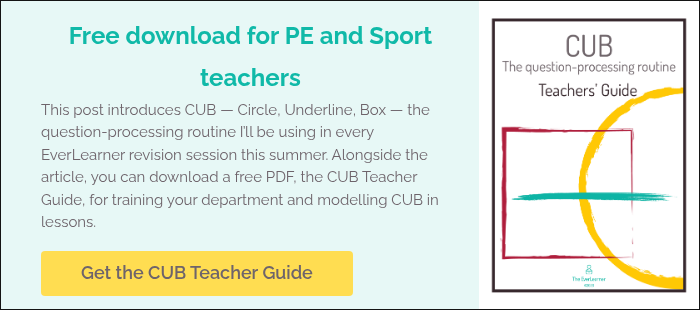
If you want something you can put straight into students’ folders or under a visualiser, we have created a free CUB Teacher Guide (click below to access it) that lays out the three steps, the command word translations, the default planning rule and the “I do, we do, you do” training sequence, along with a department embedding checklist. It is written so that you can introduce CUB in a single focused session and then keep the language alive right through to the exam.
From a last-minute rescue to a two-year advantage
I am delighted that CUB is already having an impact on this year’s exam groups. We are seeing it play out live as students slow down, spot constraints, structure answers more intelligently and pick up marks they would previously have left on the table. For this cohort, CUB is rightly functioning as a last-minute rescue tool in the final stretch. The real power of this approach, though, is when it is not a rescue at all. It is when exam technique, including how to process questions, is a two-year experience and not a two-week panic.That is why CUB is built into the dedicated Exam Technique course on TheEverLearner.com, and why Exam Technique sits at the heart of our Gold package for departments. Gold is designed so that your students meet routines like CUB early in their course and use them on every exam-style question, across GCSE, A-level and BTEC Sport, rather than encountering them for the first time when the exam clock is already running. If you are teaching Year 9, 10 or 12, it may be worth asking yourself what it would look like if your next cohort lived with CUB for two years, not two weeks.
Teaching and revision in this season are intense. None of us feels like we have enough time, and yet, small, repeatable routines like CUB can give students both a sense of control and a few extra, hard-earned marks when they need them most. Writing this in the middle of a live series, I feel the same tiredness and urgency that many of you are feeling in your own departments, but I am also more convinced than ever that explicit exam technique teaching is worth the effort.
Thank you for reading. Good luck with your lessons and revision sessions this week, whether you are using our live shows, your own resources, or a mix of both.