%20Text%20(Violet).png)
Dear PE colleagues,
The summer holidays often felt quite strained for me as a PE teacher and Head of PE.
For context, I taught and managed some of the biggest-ever examination PE cohorts for over 17 years. Within that context, the summer holidays were a brittle experience. On the one hand, I was resting and recovering from intense terms of work. On the other hand, two impinging thoughts and feelings consistently overran my mind, and I want to be honest about both of them, because I suspect I am not the only one who has felt them.
The first was the thought of how my most recent examination cohorts had performed in May and June, and whether the results in August would bring feelings of success (and, let's be honest, relief). I often dwelled on whether I had done absolutely everything I could to support exam and coursework success or not. That feeling is a really difficult one to shake during July and early August. It could be the source of real concern. I remember my subconscious waking me at 3am or 4am, dwelling on gaps that had built up, on students I was worried about, on the lesson I should have taught differently or the question type we hadn't practised enough.
The second impinging thought was about my groups progressing from Year 10 to 11, or Year 12 to 13. Those students had a full year of study behind them, and then, in July and August, a one-to-two-month hole would be placed into their learning. There is nothing wrong with a rest. But there may be something structurally wrong with PE students literally stopping their studies for what could be as much as two months. I knew intuitively that my students were forgetting what they had learned. I knew that the summer gap was, in many cases, the single most effective promoter of forgetting I could possibly allow. And that knowledge sat alongside the exam anxiety, and it made everything heavier.
In both cases, my initial response was to worry and try to suppress those worries.
What my response became was to do something about them.
The first concern was about opportunity, about a sense of having given everything I could. The second was a predictor of the first. The forgetting was feeding the anxiety. And that is exactly why an appropriate summer learning programme for PE students matters. Not as an extra burden. Not as a sign that we don't trust students to rest. But as one of the most impactful learning decisions a PE department can make.
That is what TEL Summer School is. And this year, it is better than it has ever been.

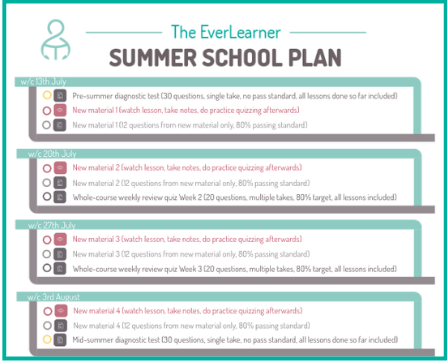
You can also access an editable version of the plan by clicking on the image below:
What the science says, and why it matters here
I want to ground this briefly in the research, because the Summer School is not built on instinct alone (though the instinct pointed in the right direction).
Ebbinghaus's forgetting curve tells us that without review, memory retention can fall below 25% within a month of the original learning event. Seven weeks of unstructured summer are not neutral. It is actively destructive to this year's work.
The forgetting cycle tells us that each time a student successfully retrieves and reviews material, the time before forgetting roughly doubles. Review is not just maintenance, but also multiplication.
And Thalheimer's reactivation curve tells us that spaced learners (students who learn, allow some forgetting, and then reactivate) outperform students who review immediately, even if the spaced learners feel less confident in the short term. The gaps between review points are not a design flaw. They are the mechanism.
That is what the 3am anxiety was tracking, before I had the language for it. The gaps were real. The forgetting was real. The Summer School is the structural response.
Introducing: TEL Summer School 2026
I am genuinely delighted to announce that TEL Summer School is back for 2026, running from the week commencing 12th July through to the week commencing 23rd August: seven structured, evidence-informed weeks.
But before I describe the structure, I want to say something about convenience, because I have heard the instinct, and I have felt it myself: "Oh, well. They couldn't possibly do this over the summer, could they?"
Colleagues, they absolutely can.
A lesson on TheEverLearner.com is a short video (around five minutes) watchable on a phone, from a garden, from anywhere. The quizzes are snappy. The whole weekly commitment asks for less time than a single episode of whatever they're watching on Netflix. We must be brave enough to ask. Students rise to the expectations we set for them, and a well-structured, genuinely accessible summer programme is a perfectly reasonable expectation.
Here is what the Summer School involves:
-
A pre-summer diagnostic test: 30 questions, single take, no pass standard. A snapshot of where students are as they leave you
-
Seven new-material units: each week, students watch a short lesson, take notes, and complete immediate practice quizzing
-
Focused new-material quizzes: 12 questions on that week's content, 80% passing standard
-
Whole-course weekly review quizzes: 25 questions drawing on everything covered so far, multiple attempts, 80% target
- A mid-summer diagnostic test and an end-of-summer diagnostic test: so students and teachers can see, in clear data, what has been retained
Those diagnostic tests deserve a moment. There is no pass standard. They are not designed to create anxiety. They are designed to create awareness. A student who arrives in September having tracked their own retention across the summer doesn't just know more. They know what they know. That metacognitive clarity is one of the most valuable things we can develop, and it costs almost nothing to build.
What's new in 2026: The exam technique track
Six years ago, when we first ran Summer School, the programme was built entirely around content. Learn this. Revisit that. Retain the other.
That was the right place to start. But this year, we have something we didn't have then: PE Exam Technique, Powered by The Roadmap.
Here's the thing I want you to consider: the Summer School model (short lesson, immediate quizzing, spaced review) is a method. It does not have to be applied exclusively to content knowledge. It applies equally well to exam skills, command-word processing, extended writing technique, and the metacognitive strategies that turn good knowledge into good marks.
The Roadmap course is built around exactly those skills. And the summer, with its lower pressure and greater flexibility, is arguably the best time to develop them, precisely because students are not simultaneously anxious about tomorrow's lesson or next week's mock. The Summer School gives them the space to practise exam thinking without exam stakes.
This year, teachers have a genuine choice: run Summer School as a content track, an exam-technique track, or (for motivated students) both. The method is the same. The application is broader than it has ever been.
This isn't just for exam classes
The Summer School is not only for Year 11 or Year 13 students facing examinations. The cognitive science applies at every level.
A Year 9 student who loses their KS3 PE knowledge over the summer before a GCSE course begins has been failed by a gap we could have prevented. Our Pre-GCSE PE, Pre-IB and broader KS3 PE courses are perfectly suited to the Summer School model. The structure is identical. What changes is the framing: not retention, but pre-study. Not defending what students already know, but building the foundations of what they are about to learn.
If you teach Year 9 and you want those students to arrive at the start of their GCSE course genuinely prepared (not just eager, but ready) this is built for exactly that.
How to set it up: Honestly, it takes 15 minutes
The Summer School runs through TheEverLearner.com's assignment system. All of the video content and quizzing is already built by TEL. Your job as the teacher is to sequence and assign it, and that is genuinely straightforward.
There are 21 assignments to set across the seven-week programme. Each one takes approximately 30 seconds to configure.
15 minutes. Once. Before the summer begins.
Log in, navigate to Assignments/Exams, select Create new assignment, choose your course, lesson and quiz, set your dates and assign to your group. The platform does the rest. Full guidance is available at help.theeverlearner.com.
How different departments are using it
The pre-study model (KS3 / Pre-GCSE PE / Pre-IB)
Assign Summer School to Year 9 students before they begin their GCSE course. They arrive in September, having already encountered key content, with a baseline diagnostic score and the habit of independent study already formed. The first lesson of the course is not an introduction but a consolidation.
The retention model (GCSE PE / A-level PE / BTEC Sport / CNAT Sport Studies & Science / NCFE H&F / CTEC Sport / IBDP SEHS)
Assign Summer School to current exam-course students. New content is introduced weekly. Whole-course review quizzes keep everything from this year alive. Students arrive in September with measurable retention data and, crucially, their independent study habit still warm.
The exam-technique model
Assign PE Exam Technique, Powered by The Roadmap through the Summer School structure. Students spend seven weeks building command-word awareness, extended-writing technique and metacognitive strategies. No content pressure. Just quiet, purposeful skill development.
The combined model (typically Year 12 into Year 13)
Assign both a content track and the exam-technique track. This is the most ambitious option, but remember, we are talking about five minutes of video and a short quiz per week. For motivated sixth-form students, this is genuinely achievable.
A note to you, directly
You have spent a full academic year fighting for your subject. You have planned lessons, marked papers, run interventions, argued for timetable time, and quietly watched PE get treated as a supporting act for more "serious" subjects.
The summer is one of the moments in the year when that hierarchy flattens. Nobody is pulling your students away. Nobody is telling them your subject matters less. You have a window of seven weeks in which a small, well-designed task can produce meaningful results.
Don't waste it by assuming they won't bother. Ask. Structure it. Set the assignments. Send the link.
They will surprise you.
Closing
The summer is coming. The forgetting will come with it, unless we do something deliberate to interrupt it.
I built the Summer School because I was tired of arriving in September and starting from scratch. I was tired of the 3am anxiety and the feeling that I hadn't done quite enough. I wanted to feel, when August results arrived, that I had left nothing on the table.
I have never regretted running it. Not once.
When I write posts like this, I am always aware of the tension between announcing something we have built and genuinely advocating for something that works. I hope this reads as the latter, because that is what it is meant to be.
Thank you for reading. If you have questions about the set-up, or want to talk through how this works for your specific context and year groups, please get in touch at james@theeverlearner.com. I would be glad to hear from you.
Have a wonderful end of term and a well-earned summer.
James