%20Text%20(Violet).png)
Within this post, I want to set out eight different ways you might choose to use the 2026 National Mock Exams (NMEs) in PE and Sport.
On the surface, not much has changed since last year: you still have exam-board-specific, paper‑specific mocks that mirror the real thing. Under the surface, however, the 2026 NMEs now sit inside a much more deliberate revision ecosystem, and they are tightly linked to our ExamSimulator diagnostics and the PE Exam Technique course – Powered by The Roadmap.
Some of the models below are quite formal and summative. Others are deeply formative and collaborative. As ever, I encourage you to take the ideas that suit you, your students and your constraints this year.
Where the 2026 NMEs sit in the revision campaign
For 2026, your PE and Sport revision offer from The EverLearner is built around a simple idea: content mastery plus exam technique, deployed over months, not days.
The National Mock Exams are one part of a wider spine that includes:
✅ Infographics – one‑page visual overviews of each paper and key topics
✅ Hot Topics 2026 – our evidence‑led view of high‑yield content areas
✅ Course‑based checkpoints – shorter, targeted practice quizzes, available on repeat
✅ Teacher and student revision notes
✅ Live revision shows and recordings across the spring and early summer
✅ ExamSimulator – for setting all of this online with diagnostics
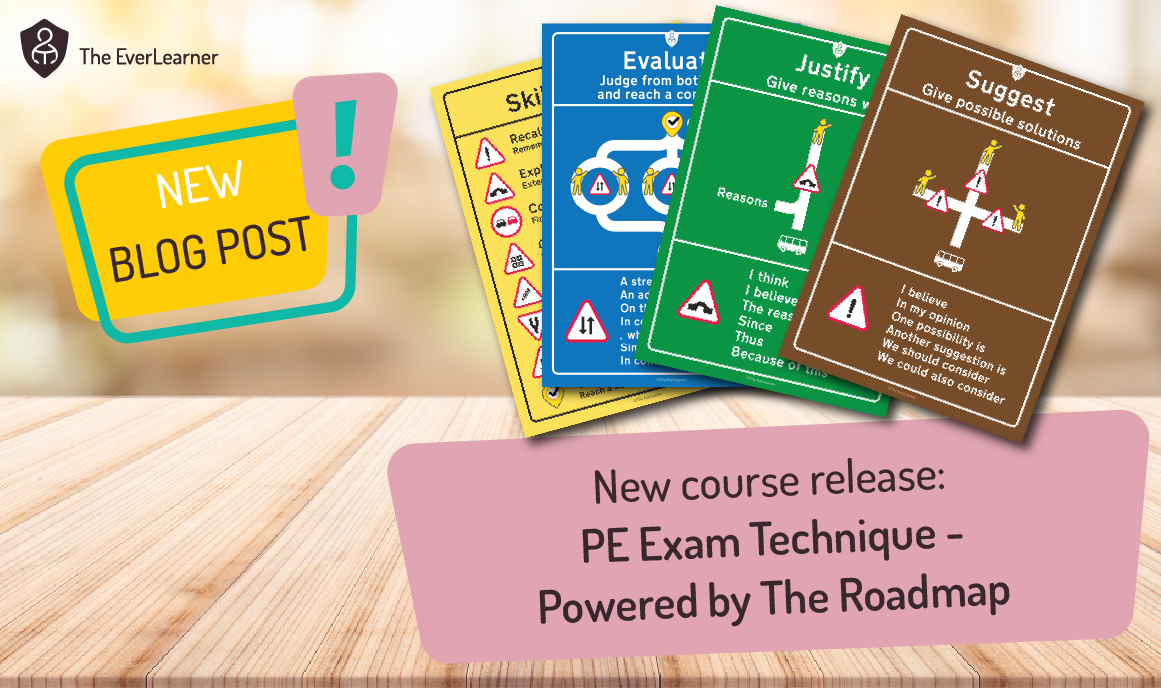
✅ PE Exam Technique – Powered by The Roadmap – our dedicated course on command words, structures, time management and exam behaviour
The NME papers and mark schemes for all major PE and Sport courses will go live in early February 2026, within days of this post. This year, they are available only to The EverLearner customers and to colleagues who have purchased our 2026 revision package.
The two foundations: content and skill
I want to stress that the NMEs are not just content drills.
They are:
✅ Exam‑board specific and paper‑specific
✅ Built from a full analysis of previous papers and mark schemes
✅ Inclusive of our 2026 Hot Topics
✅ Exact mirrors of the real exam‑board skill requirements – command words, question styles, mark tariffs and extended writing structures
✅ Designed to generate both content and skill diagnostics when used online through ExamSimulator
You are, of course, super welcome to set the NMEs on paper, but when you choose to set the NME online, your students do not simply receive a percentage grade. ExamSimulator breaks their performance into:
-
Content strands (e.g. "Advantages and disadvantages of PEDs") and
-
Skill strands (e.g. "Describe and Outline", "Justify", "Evaluate and Assess")
Crucially, the skill elements then link directly into the PE Exam Technique course. If a student is weak on "Evaluate and Assess" at 50%, they can click straight into that skill in the Exam Technique course, work through the lessons and then re‑test themselves.
This is the big difference in 2026: the NME is no longer just a mock. It is a launchpad into targeted exam‑technique intervention.
Three deployment models for 2026
Before we get into the eight ways, it is useful to picture three broad deployment models. Most departments will recognise themselves in one of these.
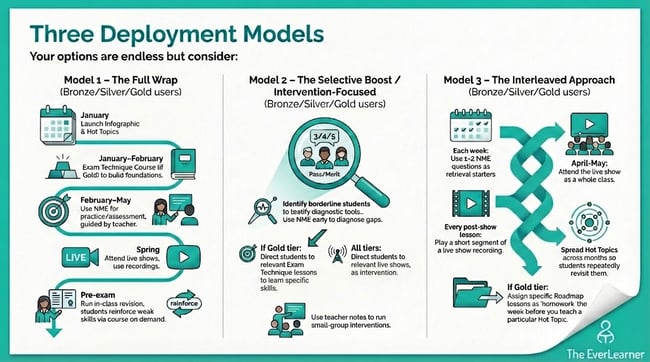
1. The Full Wrap
You wrap your entire cohort in the campaign from January to the exams:
-
Infographics and Hot Topics, introduced early
-
NME, used as a full mock and revisited in lessons
-
Live shows watched together and revisited in recordings
-
Diagnostics used to drive who does what in the Exam Technique course
2. The Selective Boost (Intervention‑focused)
You use the ecosystem more surgically:
-
NME, sat by everyone
-
Diagnostics used to identify borderline or vulnerable groups
-
Those students are then targeted with specific Exam Technique lessons, Hot Topics and live‑show segments
3. The Interleaved Approach
You weave revision and assessment into normal teaching over months:
-
NME broken into segments and used as lesson starters or mini‑assessments
-
Hot Topics and checkpoints spread out across the term
-
Exam Technique lessons used before and after key questions
You do not have to choose just one. Many colleagues will combine these. As you read the eight methods below, you might like to note which ones naturally align with your preferred model.
Eight ways to use the 2026 National Mock Exams:
- As a formal, high-fidelity mock exam
- As a flexible practice paper
- As a model paper for exam coaching
- As an editable template (Silver and Gold subscription customers only)
- As a per-lesson assessment (mini NME segments)
- As targeted extended-writing practice
- As a collaborative writing tool ('Pass the Buck' and beyond)
- As the bridge into your revision campaign
Method 1: As a formal high-fidelity, mock exam
Let us start with the classic.
From early February, customers and revision‑package schools can use the 2026 NMEs as full formal mocks. The papers are written to be sat under exam conditions and to feel like the real thing: same timing, same rhythms, same levels of difficulty.
You can set the mock:
-
Online through ExamSimulator (Silver and Gold packages)
-
On paper, using the downloadable PDFs (all annual customers and all revision‑package users)
If you set the NME online, you unlock automated marking, full content and skill diagnostics, and direct links into the Exam Technique course. If you run it on paper, you still gain an externally written, tightly attuned mock.
Best for:
-
Departments running a Full Wrap model
-
Colleagues who want clean data and a true dress rehearsal
A small word of caution: you will get powerful data, but this model is, by nature, summative. It can add assessment pressure for already‑stressed students, so I encourage you to combine it with some of the more formative methods below.
Method 2: As a flexible practice paper
You can also take the heat out of the experience and use the NME as a practice paper instead of a high‑stakes mock.
The difference is simple. You remove some or all of the assessment features:
-
No strict time limit
-
Multi‑sitting allowed
-
Some questions are tackled in class, some at home.
-
Feedback is provided during the writing process, not just at the end.
ExamSimulator makes this easy. You can open a practice exam for several days or weeks, allow students to dip in and out, and still gather data on who is engaging and how they are performing.
Best for:
-
Departments favouring the interleaved approach
-
Colleagues who want students to write plenty without overloading them with grades
You still benefit from automated analysis and personalised diagnostics when the exam is completed online, but the tone in the classroom is more relaxed and developmental.
Method 3: As a model paper for exam coaching
One of my favourite uses of the NME is to not write it at all – at least not initially.
Instead, you use it as a model paper to coach exam behaviour:
-
Walk your students through the exam structure using the paper infographic.
-
Unpick the command words systematically – what does "Analyse" really demand versus "Explain" or "Evaluate"?
-
Look closely at any data response questions or tricky imagery.
-
Talk deliberately about answer order, annotation, planning and time management.
-
Model how you would set up an extended response, including when to use structures like E‑I‑O.
In other words, you use the NME to teach students how to process an exam paper before you ask them to sit it.
If you are a Gold colleague, you can align this lesson with specific Exam Technique course segments. For example, you might show a clip from the "Analyse and Examine" lesson before you look at those questions in the paper.
Best for:
-
Full Wrap and Selective Boost models
-
Departments that know their students are underconfident with the exam itself, not just the content
Method 4: As an editable template (Silver and Gold subscription customers only)
If you are a Silver or Gold subscription customer, you can treat the NME as an editable template.
You might:
-
Remove a section you have not yet taught.
-
Swap in alternative questions to target a specific Hot Topic.
-
Build a shorter paper for a particular class.
-
Create a skills‑heavy paper by increasing the proportion of higher‑order items.
All of this can be done within ExamSimulator using our bank of thousands of alternative questions. The result is your own customised mock, still built on the spine of the 2026 NME.
When you set these adapted exams online, the diagnostics and skill‑to‑course links still work, so you retain the power of the system even as you tweak the content.
Best for:
-
Colleagues who are slightly off‑sequence with the exam board's specification
-
Intervention classes where you want to lean into particular weaknesses
There is a small amount of teacher admin involved here, but once you have built a version that works for your centre, you can reuse it year after year.
Method 5: As a per-lesson assessment (mini NME segments)
This is where the interleaved model really starts to sing.
Instead of seeing the NME as a one‑off event, you break it into smaller segments and spread them across several weeks of lessons. For example:
-
Week 1 – Section A questions as a starter, then marked and discussed
-
Week 2 – Section B questions, again marked and reflected upon
-
Week 3 – The extended response, potentially with planning time built in
Students still experience the full paper, but in manageable chunks. They get multiple opportunities to see the question style, to mark responses and to revisit the same question types more than once.
Online, this is easy to do by setting shorter practice exams. On paper, it is as simple as photocopying the relevant pages.
Best for:
-
Busy departments that want to squeeze powerful revision into normal lessons
-
Colleagues who value spacing and retrieval practice over single big events
The main limitation is that students do not feel the "full sit" unless you eventually pull it back together as a complete mock. You may therefore like to combine this model with Method 1 at the very end of your campaign.
Method 6: As targeted extended writing practice
Extended questions are still the place where many PE students leak the most marks. The 2026 NMEs, as ever, include all of the big-mark items appropriate to each course: 10-markers and 20-markers for OCR A‑level, six- and nine-markers for AQA GCSE, eight-markers for CNAT R184 and so on.
You can lift those questions out and use them as:
-
Stand‑alone extended writing tasks
-
Homework with peer marking using the NME mark scheme
-
The focus for a Pass the Buck activity (see Method 7)
Alongside this, I strongly recommend using my extended-writing frameworks for each course. These are still freely available and remain one of the simplest ways to demystify "the big question".
If you are a Gold colleague, you can align each extended‑writing task with the relevant Exam Technique lessons before students write, so that structures and command words are fresh in their minds.
Best for:
-
Departments that know that AO3 style questions are the main barrier to 7–9 and A/A* outcomes
-
Any colleague who feels their students freeze when they see a double‑figure mark tariff
Method 7: As a collaborative writing tool ( "Pass the Buck")
If you are using the NME as a practice paper or after running it as an assessment, please consider collaborative writing.
One of the most powerful structures I know is "Pass the Buck”. The basic idea is simple:
-
Students work in pairs with a copy of the NME.
-
You set a strict time window for writing – perhaps three or four minutes per question.
-
At your signal, each pair passes their script to the next table, and they receive another pair's work.
-
The new pair continues the answer, improves it, adds examples, tidies the structure and so on.
-
You repeat until every pair has seen and contributed to multiple responses.
By the end, every student has read the ideas and language of all their peers. The atmosphere is usually noisy, energised and highly focused.
You can run Pass the Buck on short or extended questions, with or without the mark scheme visible, online or on paper. If you want an extra layer, you can run a whole‑class marking conversation at the end, using the NME mark scheme on the board.
Best for:
-
Building confidence and fluency with exam language
-
Classes that need energy and variety in the run-up to exams
Assessment of individuals is messier in this model, but as a learning experience, it is outstanding.
Method 8: As the bridge into your revision campaign
Finally, I want to encourage you to use the NME as a bridge into the rest of the 2026 revision offer rather than a one‑off event.
A powerful sequence looks something like this:
-
Students sit the NME – formally or as a practice paper.
-
Diagnostics are generated through ExamSimulator (Silver and Gold).
-
Skill weaknesses are clicked straight into the PE Exam Technique course, where students work through the relevant lessons.
-
Content gaps are mapped onto Hot Topics and course checkpoints, which you then build into lessons, homework and live‑show attendance.
-
Students then attend the live revision shows (or watch the recordings) with their own mock paper experience in mind, so everything lands more deeply.
In other words, the NME becomes step one in a loop: Assess → Diagnose → Teach → Re‑assess, both for content and for skill.
This is the model that, in my experience, creates the most confident, exam‑ready PE students. It is also the model that best reflects the research on retrieval practice, spacing and metacognition.
What each tier unlocks around the NME
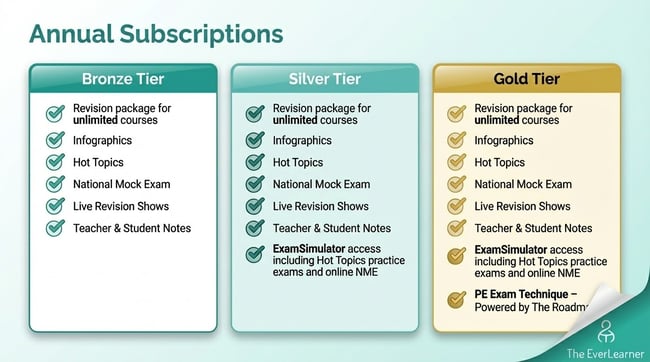
As you probably know, all our subscription packages include access to tutorials, quizzing, testing, checkpoints and analytics. However, when it comes revision, this is what you get with each package:
🔥Bronze package
-
NME papers and mark schemes (all supported courses)
-
Infographics, Hot Topics, live shows, teacher and student notes
🔥🔥Silver package
-
Everything in Bronze, plus ExamSimulator access, including:
-
Online sitting of the NME and Hot Topics practice exams
-
Automated marking and full diagnostics
🔥🔥🔥Gold package
-
Everything in Silver, plus the PE Exam Technique course – Powered by The Roadmap, which links directly to the skill diagnostics from every online exam
If you are currently on Bronze and you would like those diagnostics and exam‑technique links for 2026, I would strongly encourage you to consider moving up to Silver or Gold.
Next steps and how to get access
The 2026 National Mock Exams will go live in early February 2026 for all supported PE and Sport qualifications.
-
Existing customers – If you would like to upgrade your package from Bronze to Silver or Silver to Gold for this year's revision campaign, please contact our team directly. They will talk you through the options and help you choose the right level for your department.
-
Non‑customers – If you would like to bring the full 2026 revision package, including the NMEs, into your department, now is the time to request a quote and secure access.
Folks, I genuinely believe there is something here for every PE department, whatever your context and constraints. Whether you are going for a full wrap‑around campaign or just want to sharpen what you already do, the 2026 NMEs can give you real leverage this year.
Have a lovely day.
James.