%20Text%20(Violet).png)
If you are an AQA A-level PE student, it is in your interest to read this post. The AQA A-level PE exams are tough challenges ahead of you and I want to try and help you navigate them with more clarity, confidence and awareness. By way of an introduction, I am James Simms. I am an experienced PE teacher and Head of PE and I spent a large chunk of my career managing very large scale A-level PE programmes in specialist sixth form colleges. I am also a PE teacher at TheEverLearner.com with the specific intent of supporting A-level PE students to perform better in exams.
Within this article, I am aiming to provide you with 10 critical tips that will help you to achieve better in your AQA A-level PE exams this summer. You will notice that I am not including base concepts such as making an exam timetable, getting plenty of sleep and managing stress. Anyone can give you these suggestions. My 10 tips are specific to AQA A-level PE and, in most cases, will not be provided to you by other people.
The 10 tips are not in priority order. Each will have greater and lesser meaning for each of you individually. Take your time with this post. Read it in sections if you need to but, most importantly, take action based on what is contained.
Before we get started, I am writing this post aimed primarily at students of AQA A-level PE. If you are an OCR A-level PE student, you can read the equivalent post for your course here. 🙂
My 10 top tips:
- Practise skills as much as you practise content.
- Over-learn common question types.
- Be prepared to explain why/how on every topic.
- Over-learn the most assessed topics but learn EVERYTHING well.
- Use these questions when revising every single topic.
- Complete the National Mock Exam and act on your diagnostic.
- Over-learn the structure of our model answers when we publish them during the live revision shows
- Learn the requirements for extended writing.
- Change the order in which you complete the papers.
- Take part in my pre-exam revision sessions in May.
OK, so without further ado, let's dive in.
Top Tip #1: Practise skills as much as you practise content
It is incredibly easy to view your A-level PE exams as content exams. You’re probably thinking about energy systems and learning theories, the impact of commercialisation on performers, etc. This is completely normal. However, I want to encourage you to think about this content in context so that when you are asked about energy systems, say, you can represent your knowledge in the best possible way.
Your specification has assessment objectives. In essence, these are how you represent your knowledge. For your course, the assessment objectives can be summarised as follows:
Assessment Objective 1: Knowledge and understanding of concepts.
Assessment Objective 2: Ability to link knowledge and understanding to examples.
Assessment Objective 3: Ability to evaluate and/or analyse concepts.
I am simplifying these requirements but, in all cases, these objectives are represented by types of questions (skills) in your exams.
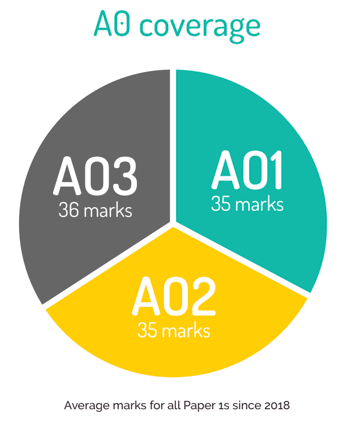
Let’s focus on AQA A-level PE Paper 1. On average, 71 out of the 105 marks available come from something other than just knowledge (AO1):
And this is represented by the typical commands that AQA provide within questions:
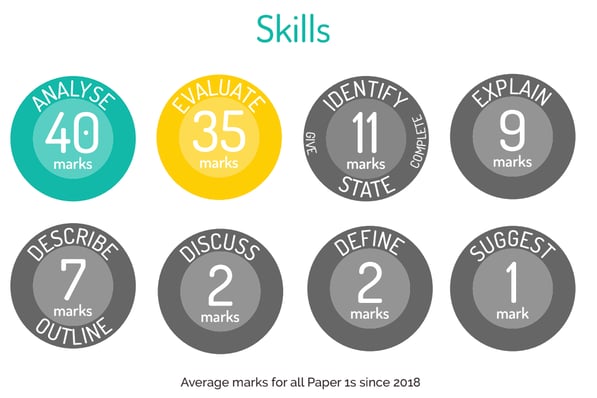
“Analyse” (a broadly AO3 skill) is the most used command. After that, “Evaluate”, another AO3 command is very significant. In other words, we can establish not just what you might be asked but also how you might be asked it. This is a major advantage to an A-level PE student (you). If you are able to over-focus your preparations on analysis and evaluations, this will stand you in good stead assuming that you do not neglect the other skills, all of which are relevant too.
Top Tip #2: Over-learn common question types
By reading tip #1, you probably already realise that I strongly believe in having full awareness of what to expect in your exams. With this in mind, I want to focus on question types.
Once again, focusing on AQA paper 1 (average marks for all paper 1s since 2018), take a look below:
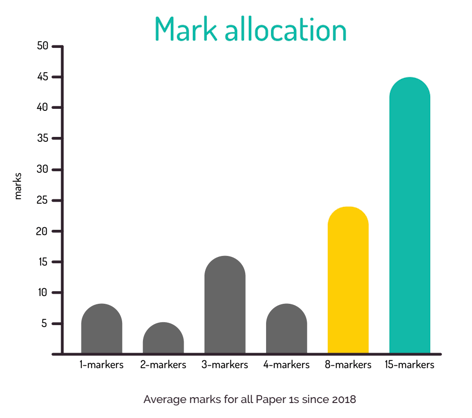
From this data, we can summarise that practising 15-mark and 8-mark questions would have a very significant impact when preparing for Paper 1. If we combine this with our awareness of the “Analyse” and “Evaluate” skills, for example, we can summarise further that practising 15-mark and 8-mark “Analyse” and “Evaluate” questions for Paper 1 would be worthwhile. Once again, we need to ensure that we practise all question types but the data analysis helps us to prioritise our time. However, it is also worth noticing the relative importance of three-markers as the most significant non-extended writing skill.
Now, let’s compare this to AQA Paper 2 (average marks for all paper 2s since 2018):
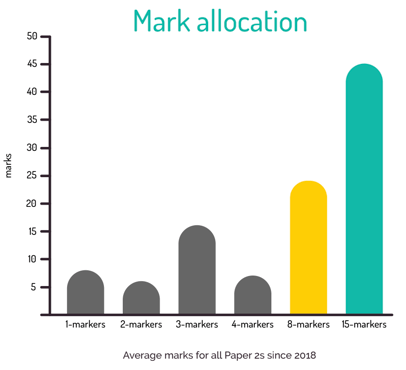
For Paper 2, the same trend emerges. 15 and 8-mark questions are the most critical practice that you, an AQA A-level PE student can do. Once again, three-markers are a reliable source of high-impact exam practice.
Now that you know this, how does this impact your preparations for each paper? What are you going to do differently as a result? If the answer is “Nothing”, you are under-preparing. Equally, if you tell me that you are only going to practise 15-mark “Analyse” questions for Paper 1 and 2, you are over-applying these principles.
Top tip #3: Be prepared to explain why/how on every topic
It is essential that you learn your PE studies for meaning. Being able to define or identify is not enough. You must be able to explain why and explain how something happens. Get in the habit of expecting this from your teacher too. Asking them questions (see below) such as “Sir, why is that the case?” or “Miss, could you tell me how that happens?” is essential and you should do this relentlessly. Your teacher will typically provide you with these explanations without you asking but if you feel unsure or, perhaps, the explanation needs to be provided again, make a point of asking this question.
Another thing that I recommend that you get in the habit of is demonstrating that you can explain things. Once you have learned a concept, ask a peer, your teacher or a parent if you can explain it to them. If they understand it too, your explanation is likely to be strong.
Take this example:
This is the statement of a fact. In other words, it is knowledge (AO1) but we want to elevate it to the level of understanding. Here’s my explanation of how this happens:
It might not seem like much but I am taking my knowledge further. I am stating how.
Now consider me providing you with an explanation without the concept being named. Can you tell me what I am explaining?
I am ensuring that I understand the concept. This is what you must ensure too. If you achieve it, other skills such as making examples or even evaluating become far easier.
Top tip #4: Over-learn the most assessed topics but learn EVERYTHING well
Trying to predict an exam is a dangerous game and what I write below is certainly not an attempt to achieve that. However, data trends do inform us of areas of priority. Take a look at the most assessed topics across Papers 1 and 2:
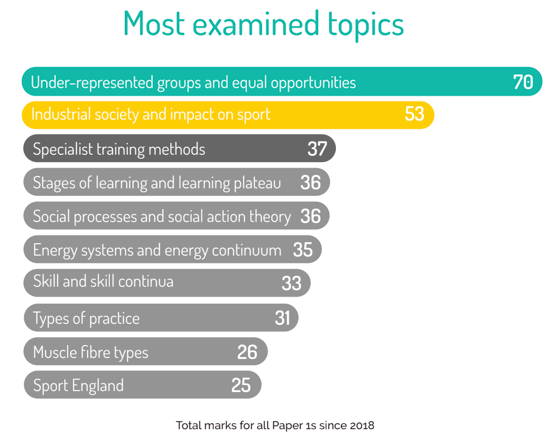
Total marks for all Paper 1s since 2018
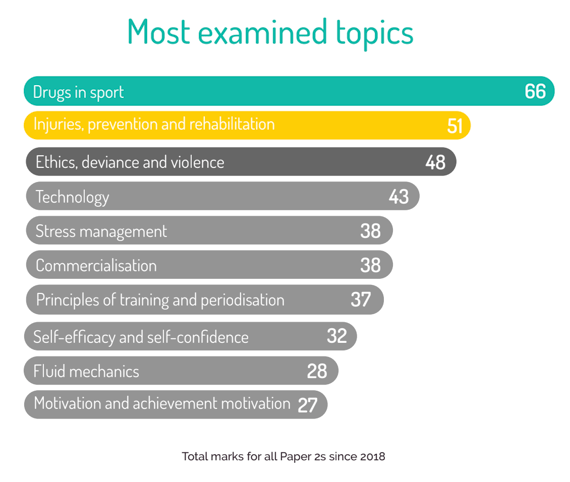
Total marks for all Paper 2s since 2018
Let’s use the example of Paper 1 and focus on types of practice. We know that types of practice has accrued 31 marks over eight papers (2018 - 2025). We also know that types of practice have not appeared on a paper since 2023:

So, would you agree with me that establishing an outstanding understanding of types of practice is a good use of your exam preparation time? Would you agree with me that types of practice is a possibility for an extended-writing piece? Would you agree with me that types of practice can be questioned using AO1, AO2 and AO3 skills? Hopefully, your answers to these questions are “Yes” and you can make informed decisions on how to prepare your knowledge of this topic in preparation for the summer Paper 1 exam.
IMPORTANT: It is my responsibility to tell you categorically that revising only some material for your exams is a very bad idea. Look back at the title of this section. It says: Top tip #4: Over-learn the most assessed topics but learn EVERYTHING well. Ensure that this is exactly what you do.
Top tip #5: Use these questions when revising every single topic
You have already read about the need to be able to “explain why” and “explain how” but we can take this further. Your A-level PE exams are skill papers just as much as they are content papers. Therefore, “thinking about” each topic with the following prompts in mind will help you. Typically it is me (a classroom teacher) asking these questions to my students but, as you will probably be revising alone, you can ask them of yourself. If you are a teacher, ask these questions of your students throughout their study:
- Define X precisely.
- Explain to me exactly how X happens.
- Explain to me exactly why X happens.
- Explain to me exactly why X is important to a performer of your choice.
- Convince me that X is true.
- Can X be broken down into segments/sections? If so, what are they?
- Can X be broken down into phases? If so, what are they?
- Describe the data trend to me from the table. Use specific values to support your answer.
- Describe the data trend to me from the graph. Reference the title, axes and data points from the graph to support your answer.
- Tell me how X and Y are different.
- Tell me how X and Y are similar.
- Is X definitely true? Has anyone ever argued X differently?
- Tell me why you broadly agree/disagree with this statement about X.
- Now you have the facts, tell me the other side of the story. When is X different from how we have learned it?
- Criticise X. Find everything that is wrong with X.
- Regardless of your own opinion of X, tell me why someone would agree/disagree with X.
- Based on your opinion of X, tell me what evidence you would need to receive to change your opinion about X.
Now, I could go on and on and on. My students, all of whom I am going to ask to read this article, will be familiar with these questions. Give or take, they are the only questions/prompts that I use when teaching. If you are a teacher, I want you to notice that I am putting agency in the hands of students. I also want you to notice that these are skill questions. I ask them because they focus on the relevant skills of A-level PE learning via A-level PE content.
Teachers who are interested in this type of questioning should definitely read my series on classroom questioning techniques. I currently have three articles on this and you can find them here:
Top tip #6: Complete the National Mock Exam and act on your diagnostic
Many of the ideas from above are best expressed if you take the National Mock Exam for your course. The National Mock Exam is all of the following:
- An exact replica of the exam-board requirements for your course.
- Based on the data trends.
- Completely unseen questions and mark schemes.
The National Mock Exam will give you a true flavour of your exams. We anticipate that well over 50% of all the students sitting PE exams in 2026 will use the mock exams, so make sure you are one of them. Otherwise, you may be disadvantaged compared to others.
Furthermore, if you complete the National Mock Exam under assessment conditions, you can use it to achieve a diagnostic on your performance. The idea of the diagnostic is to give you specific foci for both content and skills.
Top tip #7: Over-learn the structure of our model answers when we publish them during the live revision shows
In May 2026, we will be publishing model answers for many of the questions contained in the mock exam papers. This will occur during our live revision shows. I have a simple message for you: LEARN THEM! I want to be clear, I am not just asking you to read the model answers but to learn them, if necessary, by heart.
When I write model answers for students, I am aiming to provide them with world-class responses to specific questions. If you remember from the points above that my mock exam papers are written with the exact data trends of your exam board in mind, learning the model answers is a very good use of your time and could have a significant impact on the quality of your own exam performance.
I will include below an example of a model answer from 2022. This is just for guidance and to give you an insight into what to expect in May:
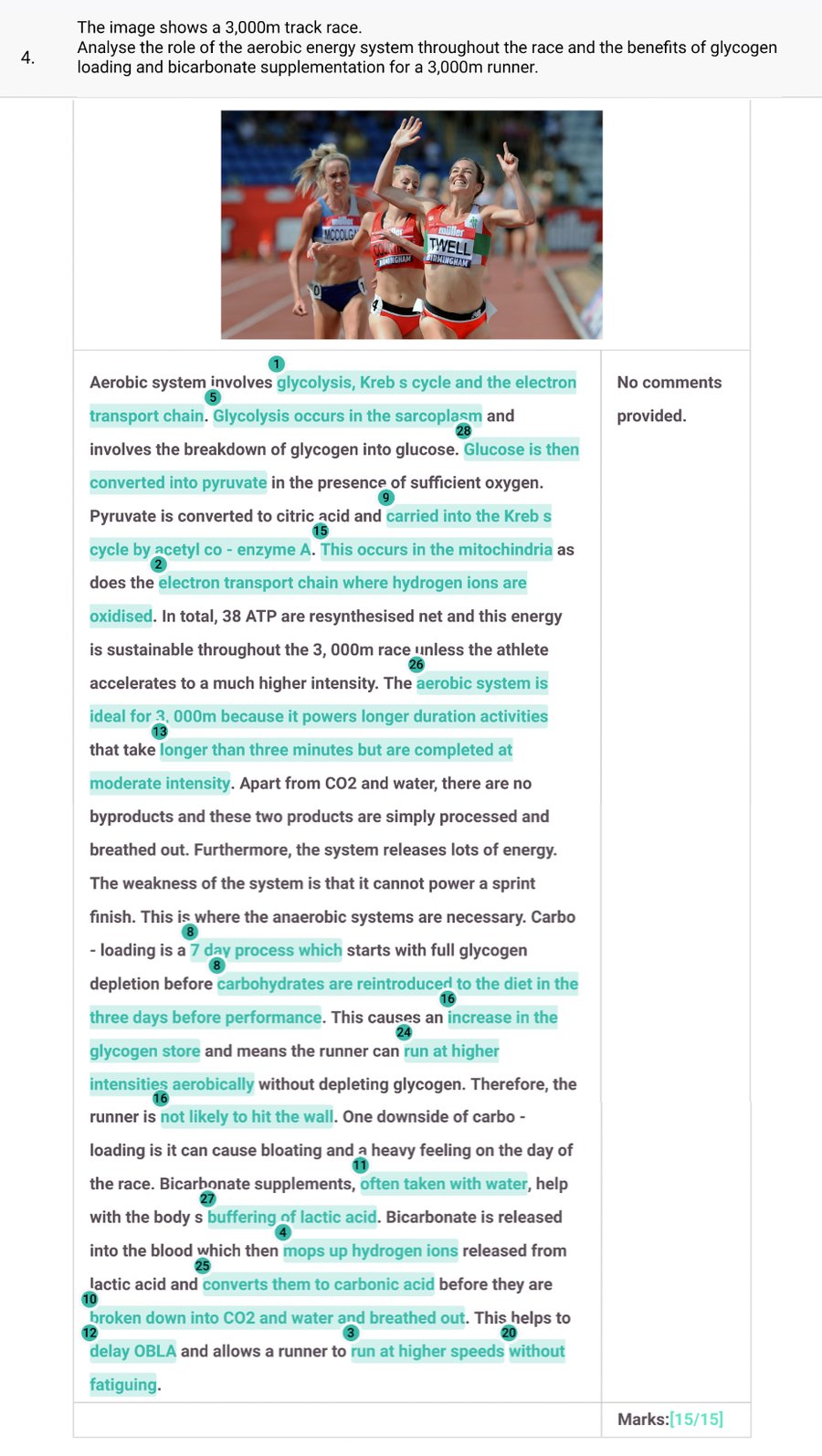 Example from my model answers AQA A-level PE Paper 1 2022.
Top tip #8: Learn the requirements for extended writing
Every A-level PE paper includes the need for extended writing. You will be writing essays in your exams. I have produced specific guidance on how to format your model answers but, beyond this, I strongly recommend that you are fully aware of the history of extended writing requirements for your exams. Take a look below:
AQA Paper 1 Extended Writing 8-mark questions.
|
Series |
Main (AO3) command |
Marks |
Topic area(s) |
| Summer 2018 |
Analyse |
8 | Factors affecting VO2 max |
|
Analyse |
8 |
1. Factors affecting response time 2. Strategies to improve response time |
|
|
Evaluate |
8 |
Socialisation - primary and secondary |
|
| Summer 2019 | Analyse | 8 | Redistribution of blood |
| Analyse | 8 | Schmidt's schema theory | |
| Evaluate | 8 | Social structure/stratification | |
| Summer 2020 | Analyse | 8 | Venous return |
| Evaluate | 8 | Types of purpose of feedback | |
| Evaluate | 8 | Underrepresented groups - Gender | |
|
Summer 2021 |
Evaluate | 8 | Specialist training method - HIIT |
| Evaluate | 8 | Methods of guidance | |
| Analyse | 8 | Industrial and post industrial (1780 - 1900) - 3 tier class system | |
|
Summer 2022 |
Evaluate | 8 | Specialist training method - Altitude |
| Evaluate | 8 | Learning plateau / Impact of learning transfer | |
| Evaluate | 8 | Industrial and post industrial (1780 - 1900) - Factories | |
|
Summer 2023
|
Evaluate | 8 | Specialist training methods |
| Evaluate | 8 | Types of practice | |
| Evaluate | 8 | Changing status of amateurs and professionals | |
|
Summer 2024
|
Evaluate | 8 | Specialist training methods |
| Evaluate | 8 | Feedback AND stages of learning | |
| Analyse | 8 | Golden triangle | |
|
Summer 2025
|
Evaluate | 8 | VO2max tests |
| Evaluate | 8 | Learning theories | |
| Analyse | 8 | Development of track and field |
What summary can we make of this table? We certainly know the following:
- You will write three eight-mark responses for Paper 1.
- It is most likely that you will be asked to “Evaluate” or “Analyse” but “Evaluate” is most common.
- You will be required to cover two topics for some of your eight-mark responses.
AQA Paper 1 Extended Writing 15-mark questions
|
Series |
Main (AO3) command |
Marks |
Topic area(s) |
| Summer 2018 | Evaluate | 15 | Proprioceptors in PNF - muscle spindles |
| Evaluate | 15 | 1. Skill continua 2. Types of practice |
|
| Evaluate | 15 | Underrepresented groups - Disability | |
| Summer 2019 | Analyse | 15 | 1. Energy transfer - ATP-PC system 2. Energy transfer - Anaerobic glycolytic |
| Analyse | 15 | Information processing - Input Strategies to improve information processing |
|
| Analyse | 15 | Underrepresented groups - Gender | |
| Summer 2020 | Analyse | 15 | Movement analysis |
| Analyse | 15 | Baddeley & Hitch working model of memory | |
| Analyse | 15 | Industrial and post industrial (1780 - 1900) - all | |
| Summer 2021 | Analyse | 15 | Muscle fibre types |
| Analyse | 15 | Skill continua Transfer of learning |
|
| Analyse | 15 | Key terms relating to equal opportunities | |
| Summer 2022 | Analyse | 15 | Energy transfer - Aerobic energy system |
| Evaluate | 15 | Types of practice Stages of learning |
|
| Analyse | 15 | Sport England, local and national partners at grass roots level | |
| Summer 2023 |
Evaluate | 15 | Factors affecting VO2max |
| Analyse | 15 | Whiting's Model AND Arousal theories | |
| Analyse | 15 | Characteristics of industrial society AND development of football | |
| Summer 2024 |
Analyse | 15 | Muscle fibre recruitment AND Newton's laws |
| Evaluate | 15 | Methods of presenting practice AND skill continua | |
| Evaluate | 15 | Under-represented groups and equal opportunities | |
| Summer 2025 |
Analyse | 15 | Muscle fibre types AND energy systems |
| Evaluate | 15 | Strategies to improve response time AND diet and supplements | |
| Evaluate | 15 | Changing status of women in sport AND under-represented groups and equal opportunities |
What summary can we make of this table? We certainly know the following:
- You will write three 15-mark responses for Paper 1.
- It is most likely that you will be asked to “Analyse” or “Evaluate” but “Analyse” is most common.
- You will be required to cover two topics for many of your 15-mark responses and these questions will be synoptic.
AQA Paper 2 Extended Writing 8-mark questions.
|
Series |
Main (AO3) command |
Marks |
Topic area(s) |
| Summer 2018 | Evaluate | 8 | 1. Dietary supplements / manipulation 2. Effects of drugs on the performer/performance - Anabolic steroids |
| Evaluate | 8 | 1. Stress management - cognitive techniques 2. Stress management - somatic techniques |
|
| Evaluate | 8 | GPS and motion tracking | |
| Summer 2019 | Evaluate | 8 | Injury rehabilitation methods |
| Analyse | 8 | Attribution theory - Weiner | |
| Analyse | 8 | Concepts of physical activity and sport | |
| Summer 2020 | Analyse | 8 | Principles of periodisation |
| Analyse | 8 | Theories of arousal | |
| Evaluate | 8 | Commercialisation - Sport | |
| Summer 2021 | Analyse | 8 | Principles of training |
| Analyse | 8 | 1. Stress management - cognitive techniques 2. Theories of arousal |
|
| Evaluate | 8 | Effects of drugs on the performer/performance - EPO | |
| Summer 2022 | Evaluate | 8 | Injury prevention methods - screening |
| Analyse | 8 | Attribution theory - Learned helplessness | |
| Evaluate | 8 | Ethics in sport - key terms | |
| Summer 2023 |
Analyse | 8 | Lever classification and mechanical advantage |
| Analyse | 8 | Achievement motivation | |
| Evaluate | 8 | Technology AND under-represented groups and equal opportunities | |
| Summer 2024 |
Analyse | 8 | Diet and supplements AND Injuries, prevention and rehabilitation, recovery from exercise |
| Evaluate | 8 | Personality | |
| Evaluate | 8 | Drugs in sport AND anxiety | |
| Summer 2025 |
Analyse | 8 | Diet and supplements |
| Evaluate | 8 | Aggression | |
| Analyse | 8 | Technology |
What summary can we make of this table? We certainly know the following:
- You will write three eight-mark responses for Paper 2.
- It is most likely that you will be asked to “Evaluate” or “Analyse” and these commands are equally common.
- You will be required to cover two topics for some of your eight-mark responses.
AQA Paper 2 Extended Writing 15-mark questions.
|
Series |
Main (AO3) command |
Marks |
Topic area(s) |
| Summer 2018 | Analyse | 15 | 1. Bernoulli principle - downward lift force 2. Dynamic fluid force - drag and lift |
| Analyse | 15 | 1. Bandura's model of self efficacy 2. Vealey's model of self confidence |
|
| Analyse | 15 | 1. Strategies for preventing violence 2. Theories of aggression |
|
| Summer 2019 | Analyse | 15 | Projectile motion |
| Evaluate | 15 | 1. Warm up for stress management 2. Injury prevention methods - warm up |
|
| Analyse | 15 | 1. Reasons for drugs in sport (social & psychological) 2. Implications of drug taking (performer and sport) |
|
| Summer 2020 | Analyse | 15 | Newton’s laws of linear motion |
| Analyse | 15 | 1. Steiner 2. Strategies to improve cohesion, group productivity and overcome social loafing. |
|
| Evaluate | 15 | Strategies to eliminate drugs in sport | |
| Summer 2021 | Analyse | 15 | Conservation of angular momentum |
| Evaluate | 15 | Measuring anxiety | |
| Analyse | 15 | 1. NIS 2. Progression from Talent ID to elite performance |
|
| Summer 2022 | Analyse | 15 | 1. Projectile motion 2. Bernoulli principle - upward lift force |
| Analyse | 15 | Chelladurai's multi dimensional model of leadership | |
| Evaluate | 15 | 1. Commercialisation - Performer 2. Bandura's model of self efficacy |
|
| Summer 2023 |
Analyse | 15 | Injuries, prevention and rehabilitation, recovery from exercise AND gaseous exchange |
| Analyse | 15 | Stress management | |
| Evaluate | 15 | Commercialisation | |
| Summer 2024 |
Evaluate | 15 | Principles of training and periodisation |
| Evaluate | 15 | Motivation AND factors affecting VO2max | |
| Evaluate | 15 | Ethics, deviance and violence | |
| Summer 2025 |
Analyse | 15 | Lever classification AND applied movement analysis |
| Analyse | 15 | Attitudes | |
| Evaluate | 15 | Drugs in sport |
What summary can we make of this table? We certainly know the following:
- You will write three 15-mark responses for Paper 2.
- It is most likely that you will be asked to “Analyse” or “Evaluate” but “Analyse” is most common.
- You will be required to cover two topics for many of your 15-mark responses and these questions will be synoptic.
So, all in all, monitoring these trends gives us an excellent insight into how to prepare for extended writing.
Top tip #9: Change the order in which you complete the papers
In general, students start answering their exam papers at question 1 and end it by answering the extended-writing question. I recommend that you change this.
I want to be clear here: you have complete choice about whether you do this but here is my recommendation:
- Invigilator tells you to start.
- Turn straight to eight and 15-mark questions for each section. Spend a few moments considering these extended writing pieces and what they are asking of you.
- Return to the front of the paper and now spend 2-3 minutes reading each question in turn without answering them.
- Return to the front of the paper and answer question 1. Continue until the end of the paper.
- As you write your shorter-answer responses it is likely that your mind will process the other questions on the paper, including the extended writing. You may recall definitions or facts or even ideas about examples. You should have some extra exam paper (ask for this from the invigilator) next to you. Note down all of your ideas there so that when you arrive at the extended-writing question you already have some ideas recorded.
I would like to think that at the start of every A-level PE exam in every school, every A-level PE student will be asking for extra paper. You should do this as it is good practice. Whilst this might annoy a few invigilators, it will be a sign of students en masse doing things the right way.
Top tip #10: Take part in my pre-exam revision sessions in May
To finish this off, I want to keep things very simple. In May 2026, you can take part in a series of online revision sessions with me. Full details can be found here.
Every session guarantees you the following:
- Exam infographics.
- Downloadable notes booklet for students.
- Downloadable notes booklet for teachers.
- Mock exam to practise or review.
- Mock exam mark scheme to self-mark your writing.
- Mock exam model answers demonstrated during the live show.
- Live and recorded session of me teaching both the content and the skills of your course.
Thank you for reading this post. Please leave a comment if you have a question about anything that is contained.