%20Text%20(Violet).png)
When Elle and I (Kim) attended a keynote speech delivered by Dr Emma Ross at the FOBISIA PE and Sport Conference in Malaysia in September, we came away inspired and keen to continue the conversation around supporting girls in PE and Sport, but also in helping teachers to address the barriers they face.
Emma is the co-founder and Chief Scientific Officer at The Well HQ. Before this, she was the Head of Physiology at the English Institute of Sport (now the UK Sports Institute) and a senior lecturer in Sport and Exercise Physiology. Emma's research and practice around female athletes, menstrual health and girls' participation in sport has been transformative in elite environments. However, what struck us most was how directly her insights translate to what secondary PE teachers are navigating every single day in our schools.
We were fortunate to be able to develop this conversation this week, when Emma joined us on our Changing Rooms podcast, which is available for you to listen to here. It was a truly fascinating conversation, and we urge all colleagues to listen in full. In the meantime, here’s a summary of the key things that Andy and I learnt when speaking to Emma this week.

There’s no single solution.
One of the most validating moments in our conversation came when Emma unpicked the complexity behind girls dropping out of sport. The stats are sobering:
All of these factors are playing a part, but then, if we layer on other factors (like unrealistic media comparisons which can lead to potentially dysfunctional relationships with food and fuelling, uniforms and kit designed for male bodies, and the simple reality that girls are navigating profound physical change while feeling watched and judged), it becomes clear why addressing this as a single-issue problem is fundamentally misdiagnosing it.
Emma's point resonated deeply: girls are dropping out because we haven't created environments that acknowledge and validate all the things girls are going through during puberty.
Starting the conversation earlier matters profoundly.
Both Andy and I are secondary-school PE teachers. As such, we are aware that, by the time girls start Year 7, some of these perceptions and barriers are already present and, therefore, more difficult to overcome. But Emma's timeline was eye-opening. Puberty can start as early as 8 years old in girls, with the development of breast buds and pubic hair. Periods can begin at the age of 9. Alongside these physical changes, there are, of course, emotional and psychological changes (which overlap with friendship difficulties, social comparison and the dawning awareness of how the world perceives bodies) for girls to navigate.
Emma shared research showing that 61% of girls don’t feel ready when they start their period, as they lack foundational knowledge. If girls haven't been prepared and supported through early puberty, by secondary school the window to normalise these changes is narrower. The embarrassment, confusion or anxiety are already embedded, and this makes having those conversations as teachers even more tricky to navigate.
This confirms something we already suspected: the work we do in secondary PE is vital, but others also have a key role to play. If girls have been introduced early to ideas about how their bodies will change, why strength and movement matter, and how to see themselves as physically capable, then by the time they reach us, the conversation shifts. We're building on a foundation rather than trying to undo years of doubt. It's a call to advocate for and support our primary colleagues in laying that groundwork.
"What's challenging for you today?" changes everything.
An excellent piece of advice for colleagues came when Emma talked about how to respond when a girl says she's on her period and can't do PE. Emma suggests a good approach in these instances is to ask, "What about today is really challenging for you?"
It sounds deceptively simple, but it does several things at once. It gives the girl permission to articulate what's really going on: pain, a lack of confidence in how to use certain products, low mood, lack of energy, or —let's be honest— maybe sometimes using it as a convenient way out, in which case your question addresses that kindly, but firmly. Most importantly, it shifts the frame from "You can't do PE" to "Let's problem-solve together." Sometimes the solution is a modified session, a follow-up conversation with a female colleague, or a talk about nutrition and support. And sometimes—crucially—it's not "Sit it out”, but “Let’s see what you can do.”
Emma was careful to note that male teachers don't have to own the entire conversation or become experts overnight, but they do need to engage with it. Supporting male PE teachers to have these conversations signals to girls that periods and everything around them are normal, acknowledged, and something adults will help them navigate confidently. It also signals that there's a team approach: that it's okay for a girl to have that conversation with a female colleague if she needs to, but that everyone is committed to her being supported.
Why the system got here and why it matters for teaching
Emma spent time explaining how PE teachers and coaches often come to these topics without adequate preparation. The reason isn't malice. It's structural. In UK sports science degrees, only 6% of research has been conducted on women. This means that, if you trained as a PE teacher, you probably had very little training (if any) on female physiology in your degree. All the frameworks you learned (all the coaching principles, the exercise science, etc.) were based on male physiology. It wasn't that women were excluded on purpose; it's that they were absent from the evidence base.
This could be just one of the reasons why, as a society, we don’t feel informed enough to openly discuss these topics with each other, which makes things particularly difficult for both teachers and coaches working with girls. Girls navigating these changes often don't have the necessary language to express their worries, and they may incorrectly assume that teachers and coaches may be uncomfortable talking about them as well.
That's where the shift Emma describes becomes crucial. If we create spaces where these conversations feel normal and safe—where we have the language we need to talk confidently about these things, where we don't avoid eye contact or panic, where we treat a girl's concern as legitimate—we can make positive changes.
What a supported environment looks like in practice
Near the end of our conversation, Emma painted a picture of what sport looks like when girls are supported through puberty. It's not about special treatment or lowered expectations, it's about:
- girls (and boys) understanding why they're being taught certain movements and why strength matters for their bodies (is the new curriculum the perfect opportunity for this, I would ask?);
- uniform and kit options that don't cause embarrassment;
- conversations about nutrition that frame food as fuel for performance (not restriction);
- breast support and pelvic-floor health being discussed openly and addressed;
- girls receiving tools to manage the variability in how they feel throughout the different stages of their cycle; and
- girls who want to miss a PE lesson being asked what they need so that teachers can help them feel supported.
It's not complicated or expensive. It's a shift in mindset and environment that says: "We see you. We understand your body is changing. And we're here to help you navigate that and stay in sport." Many PE departments are already moving in this direction. Emma's work, alongside The Well HQ, gives us the evidence and language to accelerate and deepen that shift.
What support is available for PE and Sport teachers?
Emma's guided coaching programme, launching in January 2026 for PE teachers supporting girls through sport, is part of this shift. This is designed for everyone involved in working with girls in sport, combining a research-based approach with actionable steps. This is not just about raising awareness and highlighting the barriers that girls and women in sport face, but about the practical application of what we, as educators, can do to put this knowledge into action. 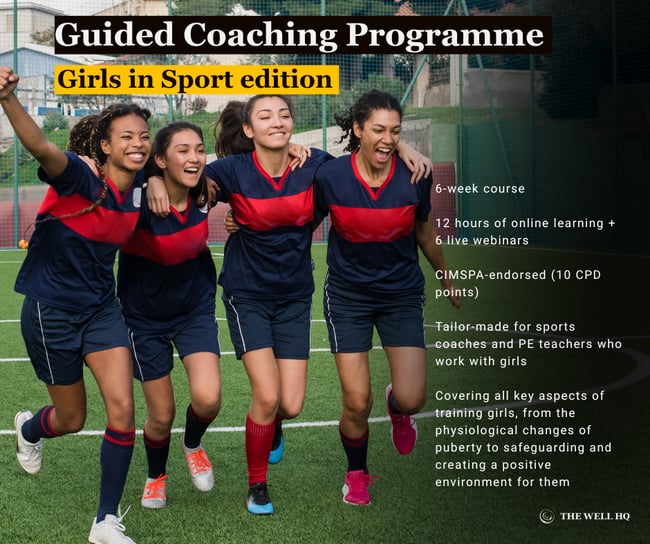
Conclusion
One thing Emma said that really stayed with us was: "We don't need to do anything massively differently. We just have to shift to an understanding and acknowledgement [of what girls are going through], and create these spaces where we can [...] nurture girls through that phase”.
That reframe — from "managing a problem" to "nurturing a person through change"— feels like the heart of it. It's what we're taking into our classrooms, to our sports fields, to our sports halls, and we think it's a conversation worth having across PE departments everywhere.
If you're interested in going deeper, Emma and The Well HQ offer a range of resources to support you: guided coaching programmes, resources, and workshops specifically for PE teachers and coaches.
We'd love to hear from colleagues. What are you already doing to create more supportive environments around these conversations? What's working? What's tricky? Drop us a message below or an email. These conversations are most powerful when we're learning from each other.
Thank you for reading, and a huge thank you to Dr Emma Ross for her time and valuable insights.
Kim Nkonde (PE Teacher at The EverLearner)