%20Text%20(Violet).png)
Dear PE colleague,
Thank you for taking a look at this week’s blog post. My aim is to provide you with an opinion piece about the possibility of changing exam boards for GCSE PE. As I write this article in late August 2026, I am mindful that I am doing so in the exact period when exam results are very recent. Some of you will be celebrating, and some of you will be frustrated. In fact, it is likely that the readers of this article will represent more heavily colleagues who have experienced frustration and seek an alternative path. In this context, let me be clear: This article is not a judgment piece about different exam boards, their staff, or their PE qualifications. Whilst I will write based on my opinions, no judgment is implied, and I simply wish to provide a balanced and honest representation of what you may wish to consider if you decide to change exam boards. I do hold value judgments about the GCSE PE courses of AQA, Edexcel, Eduqas, CIE, OCR and WJEC, but I will not represent those here. My policy is to work directly with the exam boards when there are issues and to do so behind closed doors as long as the exam board is willing to engage. In recent years, I have met with numerous colleagues from numerous exam boards and helped them to improve their qualifications. I would actually like to do this more.
Please also bear in mind that I have published my own vision for the new GCSE PE qualification, and you can read my proposed specification and why I wrote it the way I did anytime.
I have also since written the equivalent blog for A-Level PE courses which you can read here.
Why does my opinion matter?
Bluntly, that’s a good question and don’t think for a second that I am not asking myself this, too. But I am in a unique position. I am lucky enough to have two central experiences that qualify me to write this article.
Firstly, I am an experienced PE course designer and Head of PE. I spent 10 years of my teaching career at Farnborough Sixth Form College, most of it as Head of PE, and my responsibility was to produce outstanding student opportunities (and let’s be honest, results) in the biggest PE examination centre in the world. I quality assured a huge department of PE theory teachers and had experiences of en masse practical assessment, coursework quality assurance and examination preparations.
Secondly, since 2015, I have been teaching all of the GCSE PE courses on TheEverLearner.com, and the first step in doing so is very deep analysis of the specifications.
But, more than this, I have been through numerous exam board switches in my PE career. I have switched from OCR to AQA and vice versa. I have switched Edexcel to OCR and from Edexcel to AQA. I am experienced with this type of situation, including times when I looked to switch exam board when, in reality, the issues that I and my department faced were not directly down to our exam board choices. This is one of the problems I see: Is the issue you perceive with the exam board really the issue you are experiencing? This is the first question you will need to consider.
With these backgrounds and thoughts in mind, let’s get started.
To switch or not to switch? A matter of risk management
Let’s start with the most fundamental question: Should you switch exam boards at all?
When colleagues ask me this question (which, by the way, is common), I always answer in the same way. There are two primary considerations:
1. Be very cautious about switching exam boards based on one single set of results.
2. Treat exam board switches from a perspective of risk management.
So, firstly, you are encouraged not to switch boards hastily. If you have had one dodgy set of results only, take a moment before making a big decision. This could relate to exam results, Non-Examined Assessment (NEA) adjustments or your moderation experience. The point I want to make is that one set of annual results is not a trend. If we jump too soon, we are acting like Premier League football Chairpersons, firing their manager way too soon. Be cautious with this.
And, secondly, switching exam boards is all about risk. The thing is, no GCSE PE course is perfect. In fact, they are all far from perfect, so simply switching courses will not necessarily address the core issue. I have switched exam boards many times in my PE teaching career, so I am not against doing it, but you have to address the risks on both sides of the fence with the same level of scrutiny. Remember that when you switch exam boards, it is probably two years of transition, with the first of those years involving the teaching of two different courses in probably year 11 and year 10. Then, try to consider how imminently a new GCSE PE qualification will come on stream. As I write in 2026, the new GCSE courses appear to be three to four years away, so switching may be a good option. But if you read this in 2028 or 2029, the decision to shift may cause up to four years of disruption, as you switch from one legacy course to another before a brand-new qualification commences. This is a lot of change, so be warned.
You’ve made the decision to switch. Now what?
The easy part is done: You know what you want to leave behind. Fair enough. But to what and where should you go?
This is exactly where I wish to position this article. What follows is a series of practical and snappy guides to the experience of switching from one course to another and some of the issues you may face.
I should be candid from the start so my biases are understood: I have no direct affiliation with any exam board. No exam board hires me nor pays me for any work. Therefore, what follows are truly my opinions and are not sponsored in any way. I do have preferences about GCSE PE. If I were to start as a Head of PE in a brand-new PE department today, I would likely select AQA GCSE PE as my preferred course. But this shouldn’t surprise anyone, as it is the exact movement of the whole PE sector, with AQA being the most popular qualification.
With each switch, I will score my level of judgment of the switch in 2026 out of 10, with 10 being “Go ahead and do it” and 1 meaning “Don’t do it”. To be clear: this is my level of comfort with switching from one specific course to another in 2026. Please note that my scores would change as we move towards 2027 and beyond, specifically because a new tranche of qualifications are expected.
Switching to AQA
Switching from Edexcel to AQA. Recommendation score: 7/10
Both Edexcel and AQA courses are perfectly acceptable options for GCSE PE, but AQA GCSE PE is worthy of serious consideration.
Why?
Edexcel lost huge market share in 2016, going from being the dominant GCSE PE course to now the third most popular. Meanwhile, AQA GCSE PE has become the dominant qualification and is an excellent option for PE departments.
Advantages to the switch
- AQA uses exam-question command words consistently. ‘Analyse’ truly asks students to analyse. ‘Evaluate’ truly means to evaluate, etc.
-
AQA extended writing questions, whilst challenging and extensive (15 marks, rather than nine marks per paper on Edexcel), are well written, with extensive mark schemes and indicative content and offer an excellent challenge for PE students.
-
The two AQA exam papers are equally weighted.
- In my opinion, AQA GCSE PE is better preparation for future studying of PE in sixth form, compared to Edexcel.
- AQA written coursework is valid because it genuinely requires the candidate to review themselves and their activity profile. This is a useful and valuable experience for young people.
- Centre-based moderation with AQA allows centres to build a direct relationship with their moderator.
Disadvantages to the switch
-
Risk and trend: Does the switch away from Edexcel legitimately address the issues faced in the department? I have broadly detailed this consideration above, and it is not unique to the potential shift from Edexcel to AQA.
-
More extended writing (30 marks across two papers, as opposed to 18 marks with Edexcel) could be viewed as too much.
- Extended-writing topic areas are broader with AQA. Since the paper restructure from Edexcel from 2023, extended-writing questions can only be sourced from some topics, making them more predictable on the Edexcel papers.
Switching from OCR to AQA. Recommendation score: 8/10
I fear that some PE colleagues may find I’m a little hard on OCR GCSE PE, but I also have to represent my own experiences and opinions. OCR GCSE PE is the second most popular course, so lots of people like it. However, I am firmly of the opinion that OCR GCSE PE has some structural flaws and, as such, I must be candid about them here.
Advantages to the switch
-
AQA GCSE PE offers a better transition to future study of PE or sport-related qualifications at KS5. OCR GCSE PE offers less examination content at a shallower level and with a larger reliance on one- and two-mark questions. The cumulative effect of this is that it is deemed to be poorer preparation for A-level PE study, say.
-
As mentioned above, AQA offers a broader question profile across their exams than OCR, and this does make a difference.
OCR:
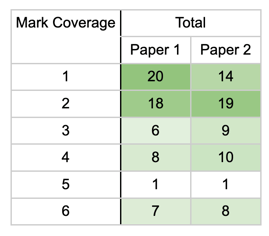
AQA:
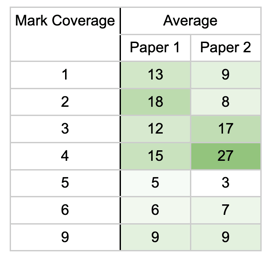
3. AQA offers more reliable grade boundaries across examination units. Because OCR papers are both marked out of 60 and AQA out of 78, OCR has a greater danger of narrow unit grade boundaries. This is deepened by the heavy usage of one- and two-markers on the OCR papers. It is tempting to believe that students undertaking lots of short questions is a good thing. It could be deemed as more accessible. But the threat of this is substantial as many, many students will achieve most of the one- and two-mark points, leaving an even narrower set of unit grade boundaries.
Important: PE teachers are reminded that selecting an “accessible” qualification is typically a false economy. PE qualifications, like any other, need to be structured to be capable of differentiating performance at every level. Ideally, every question or mark within an NEA unit needs to have the tendency to differentiate student performance based on knowledge, skill, understanding or engagement. My opinion is that OCR GCSE PE does this less well than AQA GCSE PE.
4. As mentioned previously when discussing a potential switch from Edexcel to AQA GCSE PE, there is an advantage in the AQA written NEA. Whilst the OCR written NEA has not been as catastrophic as the original version of the PEP (Edexcel written NEA used before 2023), the AQA version is a solid and reliable piece of writing that an AQA GCSE PE student does about themselves and is more likely to be “real” to them than the OCR equivalent.
5. The synoptic element of AQA GCSE PE exams is smarter than OCR GCSE PE. OCR GCSE PE requires one six-mark synoptic answer per paper. This seems very modest and many PE teachers will be attracted to OCR GCSE PE for this reason. However, there is an issue. In all OCR GCSE PE six-markers, there are two halves to the answer. One half from Paper 1 and one half from Paper 2. Easy, right? No! The reality is that OCR GCSE PE students, in order to be successful on six-markers, need to prepare their knowledge of Paper 2 content before the Paper 1 exam and Paper 1 content before the Paper 2 exam. This is not what happens and, as such, the standard of what is required on those questions has been driven ever lower. AQA does require a synoptic response in their nine-mark question, but the nature of the links is left open to the student, who may choose to link any Paper 1 ideas to their nine-mark question on Paper 1 and the equivalent for Paper 2.
Disadvantages to the switch
- Any switch from one exam board to another requires careful risk management. Ask yourself: Is the right time now? Ask yourself: Do we have enough data to be sure that we have a downturn in our OCR results as a trend?
-
Teachers switching between OCR and AQA GCSE PE will need to develop their subject knowledge to deliver the AQA course. AQA GCSE PE goes deeper, and rightly so. Therefore, teachers need to be ready for this.
- Cluster moderation will be lost when switching to AQA. AQA holds centre-based moderations per centre. Therefore, if you highly value cluster moderations (like I do at A-level, for example), this will no longer be your experience.
Switching from Eduqas or CIE IGCSE to AQA. Recommendation score: 9/10
Writing bluntly, the decision to change from Eduqas to AQA is a no-brainer. The quality of the qualifications is vastly different.
Switching from CIE IGCSE is a different consideration. If your centre is not determined by league-table performance, such as an independent or international (non-UK) school, the CIE IGCSE is a very interesting option. It offers one single exam, no exam-based AO3 (AO1 and AO2 only on the exam) and a 50/50 balance between examined content and NEA. The CIE IGCSE is very popular with British-curriculum international schools and is a potential choice for centres with the freedom to offer it.
Remember that the CIE IGCSE has different course codes for centres in the UK (1-9) and international centres (0413).
Switching to Edexcel
Switching from AQA to Edexcel. Recommendation score: 3/10
If you have read everything that I have covered so far, there is little new to add here. Speaking in broad strokes, the Edexcel course is not as strong as the AQA one, and departments looking to move from AQA to Edexcel are bucking a national trend. However, there will be centres considering this, so allow me to expand a little further.
Advantages to the switch
Sometimes change is needed. If you have a clear trend of underperformance on your AQA course, Edexcel is one of your viable alternatives.
The Edexcel course has improved significantly since 2023. Edexcel changed their NEA requirements related to the PEP and their exam structures in 2023, and what is offered now is substantially better. I have written about these changes previously, and I encourage you to read as widely as possible on this topic.
Disadvantages to the switch
Previous AQA centres will find the challenges that I have laid out above in the AQA to Edexcel commentary very helpful. Please read that section for details, which I will summarise below:
-
Edexcel exams are less consistent and less reliable than AQA exams for PE.
- The Edexcel Personal Exercise Programme (PEP) NEA has experienced problems and is deemed a lower-quality experience, compared to the AQA NEA. To be fair to Edexcel, they did improve the PEP requirements from 2023, but this improvement does not match the experience of the AQA coursework.
Switching from OCR to Edexcel. Recommendation score: 5/10
This is one of the more interesting options available to OCR centres. It is probably more logical to switch from OCR to AQA but, if that is not preferred, the Edexcel course should be. I will try to detail some useful considerations:
Advantages to the switch
-
Edexcel, whilst not as effective as AQA, is better preparation for future PE and sport study than OCR.
-
Edexcel does not require revision preparation for both content areas for both exam papers. This is the case with OCR due to the nature of the synoptic six-marker, which I have detailed in the article above.
- Edexcel carries more total examination marks than OCR, and this poses less of a grade boundary threat than OCR. Once again, this is detailed above. In summary, OCR’s Paper 1 is out of 60 marks, and Paper 2 is out of 60 marks. This provides a narrower range of total marks and impacts grade boundaries. Furthermore, the heavy use of one- and two-markers means that many questions fail to discriminate between student performance levels sufficiently.
Disadvantages to the switch
Switching brings challenges and work, and colleagues are reminded of all the words that have preceded this entry. Ensure that the data you are relying on to make this change is both reliable and can be considered a trend.
Switching from Eduqas or CIE IGCSE to Edexcel. Recommendation score: 6/10
Most of my points have been made above. If you are an Eduqas centre, Edexcel is an improvement. If you are a CIE IGCSE centre, I think it is unlikely that you will be making this switch. If you are, please take time to look at my guidance above about switching from CIE to AQA GCSE PE.
Switching to OCR
Switching from AQA to OCR. Recommendation score: 2/10
I feel that there is an irony here. Some readers of this article will be incentivised to switch from AQA to OCR despite the clear differences in qualification quality. OCR can be deemed a “more accessible” qualification than AQA and, for this reason, some of you will be contemplating this exact change. Because I wholeheartedly disagree with such a shift, I am not going to detail the advantages and disadvantages of the potential switch. Rather, I will detail some of the reasons that colleagues might be considering this and request a rethink.
Potential reasons for considering the switch
-
The exams are easier. There is some truth to this, but easy exams should not be the aim. Please be encouraged to choose a qualification which is rigorous enough to differentiate performance at every level. OCR GCSE PE struggles to achieve this.
-
The exams are shorter, with less extended writing. Once again, this is very true. OCR exams total 120 minutes across two papers, and AQA total 150 minutes. Likewise, OCR requires only 12 total marks (10% of the total) from extended-writing responses, whereas AQA requires 30 total marks (19% of the total) from extended-writing responses. I urge teachers to read my guide above on switching from OCR to AQA as to why the AQA course can be considered superior for these reasons.
- The moderation is cluster-based. This is a good argument, and some colleagues will prefer this approach. In fact, I do prefer this approach at A-level. However, at GCSE PE level, with the numbers of candidates often involved, I do think it better to have a centre-based moderation experience. GCSE PE candidates benefit more than their A-level counterparts by having the moderation at their own centre and their performances only being compared internally. On the other hand, cluster-based moderation does allow for teaching staff to gain experiences of the practices of other centres and to see their students’ performances more in context.
- It’s better to study OCR GCSE PE before OCR A-level PE in our sixth form. I wish this were true, but the reality is that OCR GCSE PE is a poor preparation for studying OCR A-level, which, by the way, is my preferred A-level PE course.
Switching from Edexcel to OCR. Recommendation score: 4/10
I, once again, refer to my notes above. As the two courses that I would not choose, I do not have a very strong preference between them. I lean towards Edexcel because it is better preparation for future PE study. Put simply, students learn more on Edexcel GCSE PE than they do on OCR GCSE PE and, as an educator, I will always lean in that direction.
However, there are strengths and weaknesses of each course and, if you need a new challenge as a previously OCR centre, Edexcel should be your second option after AQA.
Switching from Eduqas or CIE IGCSE to OCR. Recommendation score: 4/10
If you are an Eduqas centre and do not value AQA or Edexcel, OCR is your next choice and is a far better course than the Eduqas qualification. Consider it. If you are a CIE centre, OCR is worth investigating if you are switching, but should not be your first option.
Conclusions
So, it turns out that my preference for AQA is quite strong. I didn’t know that as clearly as I do now after completing this writing.
If you are switching, do so with your eyes open and be confident that you are switching for the right reasons.
Thank you for reading. I'd genuinely value hearing where you land, especially if you disagree with any of my judgment scores.
Good luck with whatever you decide.
James