%20Text%20(Violet).png)
Context
This post is written in support of my previous post, which included my own draft GCSE PE specification. This post details some of the decisions I made in relation to the three proposed NEA assessments contained within my draft GCSE PE spec (download here). I recommend readers familiarise themselves with the draft specification when reading this post.
The post
I want to open with something I believe strongly in, because I think it gets lost in most conversations about GCSE PE assessment. Assessing practical performance within GCSE PE is right. It is not just defensible. It is important. Students spend months, often years, developing physical skills in PE lessons and in sport outside school, often from a very young age. When a student can demonstrate genuine tactical awareness under pressure, deliver a gymnastics sequence with real control, or execute a technically sound skill in a competitive situation, that is an achievement. It deserves formal credit, just like a skilled musician would be credited in GCSE music. I am not interested in a GCSE PE specification that removes performance from the NEA.But here is my first position: making performance the only thing that counts is a mistake. A student who arrived in Year 10 having played club hockey since they were eight but now completely stopped playing will, in most cases, outscore a student new to hockey but who has worked harder, improved more, and learned more about their own body and how it responds to training over the course of the GCSE programme. The hockey player gets their 40% of the qualification. The grafter gets a mark which probably represents less than a Grade 4 for that specific unit for the grafting they have done. Nowhere on the mark sheet does it say: this student came in at Level 1 and left at Level 3. That journey simply does not exist in the current assessment model. My draft GCSE PE specification addresses this by equally honouring performance assessment and improvement assessment. Take a look at this example:
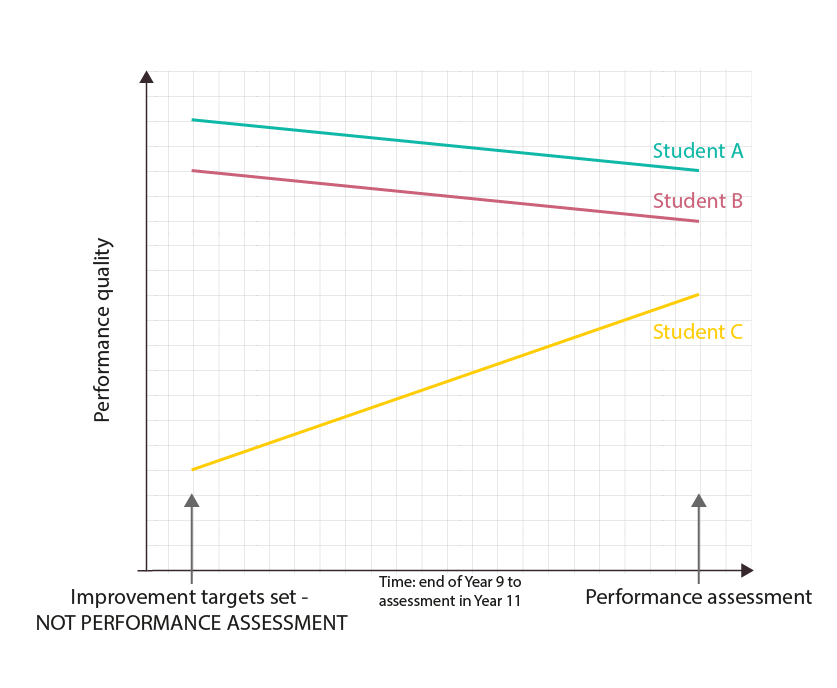
Take a look at this illustration. Student A (a clearly highly skilled sports performer) has actually regressed in their sporting performance over the two-year cycle of their GCSE PE. Perhaps they are a figure skater who used to train four times a week and has since quit. Perhaps they are a figure skater who has experienced a serious injury and been out for 18 months. Meanwhile, student B started the GCSE PE course with relatively low performance levels but has clearly worked hard to improve their performance in specific ways. On the current GCSE specifications, student A would far outperform student B in practical assessment, but in my draft specification, there is more nuance. Let’s see:
| Student | Activity | Context | My draft specification | Current specifications | ||
| Performance assessment | Improvement assessment | Overall assessment |
||||
| /20 | /40 | /40 | ||||
| A | Figure skater | Highly skilled performer who quit skating at the start of year 10 and made little to no effort at improvement. | 18 | 5 | 23 | 35 |
| B | Figure skater | Highly skilled performer who suffered an ankle break in early year 10 but worked on their improvement targets, including upper body strengthening, injury recuperation and psychological training. |
18 | 17 | 35 | 35 |
| C | Figure skater | Novice skater who, at the end of Year 9, committed to train twice a week and maintained their efforts for 18 months, including strategically achieving and surpassing their three improvement targets. |
11 | 20 | 31 |
22
|
Please take a close look at this table. Whilst it incorporates only three examples and provides only a small amount of nuance, it is really important to compare the two lower rows to the upper row. The injured figure skater and the novice figure skater are giving it everything, for want of better words, over the course of the GCSE programme. The accomplished figure skater who has stopped training, whilst credited for their lifelong quality in figure skating, has not progressed, and their assessment shows it.
Imagine the enrichment of the conversations between potential PE students and their PE teachers. Imagine how valuable this kind of message is when we market our PE course. Not only should students choose GCSE PE, but they will be credited directly for their efforts to improve. Oh! And by the way, this GCSE PE course is also the perfect antidote to the often sedentary experience of being a multi-qualification GCSE student who is incentivised to sit down and study far more hours than is probably healthy on average. This course will incentivise and reward movement and physical activity in the very stage of life that would benefit the most.
Now, for my second position: We have been setting the intellectual ceiling in the NEA far too low for far too long. Home-produced written coursework is gameable, AI-vulnerable, and at its worst, tells us more about a student's internet connection than about their thinking. But the answer is not to abandon written NEA work entirely. The answer is to supervise it properly, expect far more of it, and trust students to rise to it.
This post explains every significant decision I made about the NEA in my draft specification. There are three components. Each one exists for a specific reason.
What I used to think
Early in my career, two beliefs shaped how I approached the NEA.The first: Performance should dominate, because this is PE. I understood the criticism that less sporty students were disadvantaged, and I largely set it aside. Students who were good at sport were good at sport.
The second: GCSE PE students could not produce genuinely independent, intellectually ambitious written work under supervised conditions. That kind of task was for A-level. At GCSE, you ran observations, collected coursework folders, and hoped the marking held up at moderation.
I was wrong on both counts.
What I failed to see in the first belief was that I was confusing talent with learning. They are not the same thing. A student can improve dramatically across two years of GCSE PE and receive no credit whatsoever for that improvement. I watched it happen in my own classes for years. I should have challenged it sooner.
What I failed to see in the second belief was this: Drama students at GCSE complete substantial supervised tasks over extended periods. Art students do. Music students do. No one questions whether Year 11 Drama students can sustain independent, analytical and creative work for several hours under supervised conditions. It is simply accepted as the standard. I had been applying a lower expectation to PE students for years, and calling it realism. It was not realism. It was a failure of ambition.
The problems I was trying to solve
Growth is invisible in the current model. The NEA mark reflects where a student ended up, not what they did to get there. A significant improvement across two years of GCSE PE earns nothing. That is a flaw in the model, not a feature.Home-produced written work is no longer a valid format. Written analytical coursework produced at home, over an extended period, without supervision, was gameable before AI existed. In 2026, it is not a defensible assessment format. Any written component in a new specification must be supervised. I would like to add that I gave serious consideration to making the NEA 3 an oral assessment, but opted for written to make it more manageable at scale.
The current coursework model homogenises student writing. When every student is completing the same task at home, you get the same writing. Teachers mark thirty versions of the same text. Patterns emerge, and everyone in the profession knows it. A supervised response to a chosen case study produces completely individual work. Every student writes something different. That is not a burden. It is what assessment is actually for, and means that the full scope of assessment can be opened up in order to differentiate candidate responses.
Teacher workload around the NEA is poorly defined. The NEA generates more anxiety, more inconsistency between schools, and more time spent on things that do not improve student learning than any other component of GCSE PE. Any new model needed to define the work precisely. Hard, but finite. Specific jobs at specific times, with a clear endpoint.
The ceiling problem. Current mark schemes do not reward students who go beyond what was explicitly taught. The brightest students in a PE classroom are constrained by descriptors that only credit what appears in the specification. That is a waste of exactly the students we most need to stretch.
NEA 1 and NEA 2: Performance and improvement as equal partners
Each physical activity assessment is worth 40 marks: 20 for performance level, 20 for improvement. The same number. That is deliberate.1. Performance stays, because it should. Students who have genuinely developed physical skill deserve to be rewarded for it. The 20 marks available for performance in each activity represent a serious commitment to recognising what students have actually built. A Level 4 performance is an achievement, and the specification treats it as one.
2. Improvement earns equal marks, because growth is learning. A student who arrives at Level 1 and leaves at Level 3 has worked, adapted, and learned more, in most cases, than a student who arrived at Level 3 and stayed there. Both achievements matter. Now both receive formal credit.
3. Improvement is measured through coached targets. At the start of the course, the teacher and student agree on three specific, observable improvement targets per activity. These are recorded on a standardised form and timestamped. They cannot be revised downward once set. At the terminal assessment, the teacher judges the extent to which each target has been achieved using level descriptors. Short video evidence supports moderation.
4. Targets must be specific and observable. Vague targets are unmarkable targets. "Improve my technique" is not a target. Here are three examples from Appendix B of the draft specification, to give a clear sense of the standard expected:
Swimming: "Demonstrate a legal and efficient tumble turn in freestyle, including a push off the wall below the surface, rotation to a streamlined position, and a return to full stroke within three metres of the wall, achieving this in at least three out of five attempts."
Field hockey: "Execute a 3D skill (lift or scoop) to beat a defender in a 1v1 situation, maintaining control of the ball within two metres of landing, in at least three out of five attempts during a conditioned game."
Orienteering: "Using a 1:10,000 map, successfully navigate a course of at least five controls using a compass bearing at a minimum of two of them, completing the course within a pre-agreed target time."
These are not tick-box statements. They describe specific, observable behaviour that a student and teacher can pursue together across two years of deliberate practice.
5. The model is designed to be hard work, but finite. Here is what NEA 1 and NEA 2 actually ask of a teacher, and when:
| Stage | What the teacher does | Time required |
| Start of course (Year 10) | Agrees and records three coached targets per student per activity on the standardised form. Timestamps. | ~5 minutes per student |
| During the course | Observes progress through normal teaching. Brief professional notes only. | Built into normal teaching |
| Mid-course check (optional) | Short target-review conversation per student. Not formally assessed. | ~3 minutes per student |
| Terminal assessment window | Observes performance. Judges improvement against level descriptors, supported by short video clips. | Discrete and defined |
| Moderation preparation | Submits standardised forms and video clips. No additional writing required. | Bounded and complete |
This is not a paperwork mountain. It is a professional cycle that mirrors what good PE teachers already do informally, every week, and makes it formally count.
NEA 3: The component I am proudest of
Let me be direct. NEA 3 is the most ambitious thing in this entire specification. It is also the component I was most nervous about publishing.Here is what it asks. The exam board publishes three case studies on a set day. Each one describes an individual, their context, their activity, their situation, and gives a student enough detail to write meaningfully about health, participation or performance. Each case study is designed so that all three lenses are available to the student. Performance, it is worth saying, does not mean elite. It is relative to the person in the case study. Students choose one case study and have four supervised hours to write their response. No internet. No AI. No assistance of any kind. Just the student, their knowledge, and the task in front of them.
The response must interweave two theories from across the course in an attempt to improve the health, participation or performance of the person in the case study. Not two separate sections about two separate theories. Two theories shown to connect, to reinforce each other, and together to produce a specific and meaningful improvement for a specific person.
6. The theories will always connect, because improvement is the shared output. This is the insight behind the interweaving requirement. If a student chooses arousal theory and an understanding of the cardiorespiratory system, those two things share an output: improvement in health, participation or performance. By definition, they will overlap, if nowhere else, at the point of that improvement. The synthesis is not artificial, it is inevitable if the student understands both theories well enough to apply them honestly to the same individual.
7. What a high-scoring response actually looks like, in plain terms. The student never loses sight of the person in the case study. They apply their chosen theories continuously and specifically. Not "motivation theory generally helps performance" but: for this individual, given what we know about their context, here is what motivation theory tells us, here is what it produces when applied alongside this physiological knowledge, here is the likely improvement, here is why it matters, and here is why these two theories together are the right tools for this specific person. The theories serve the person. The person is always visible. That is the difference between a Level 2 and a Level 4 response.
8. Going beyond the specification is the ambition, not the exception. Here is what I most want colleagues to understand about what NEA 3 is for. Imagine a student who is genuinely fascinated by the cardiorespiratory system and by arousal theory. They have followed that curiosity beyond the limits of the assessed content. They have read further, thought further, and connected ideas that the specification did not ask them to connect. In the current model, there is nowhere for that student to go. The exam paper does not reward it. The old coursework task did not require it. NEA 3 is specifically designed to give that student somewhere to go. For the right student, this four-hour sitting is a genuine introduction to what extended research, independent thinking and ambitious writing actually feel like. That matters for everything that comes next in their education.
9. Four supervised hours is the right duration, and PE deserves it. I know that some colleagues will read "four supervised hours" and immediately begin calculating which lessons to sacrifice and whether the hall is free. I understand that instinct. But let me be clear. Drama students at GCSE complete substantial supervised tasks. Art students complete substantial supervised tasks. Music students complete substantial supervised tasks. Headteachers allocate the time because those departments ask for it confidently, because they believe their subject deserves it.
We should believe the same. PE, at its theoretical and applied best, demands the same intellectual rigour. A four-hour supervised session creates a discrete, controlled, defined assessment event. It removes the AI problem entirely. And it produces marking that is genuinely worth doing: completely individual pieces of writing, shaped by each student's specific interests, chosen theories and the connections they have made. No teacher will ever mark 30 versions of the same text again. That is not a burden. That is an upgrade.
10. The marking window is real work, but it is bounded. I will not pretend that marking NEA 3 is light. It requires genuine intellectual engagement with each student's individual argument. But it happens in a specific, defined window, guided by clear level descriptors. And there is something professionally meaningful about marking a student who has surprised you, who has made a connection you did not predict, who has applied two theories to a human being with real precision and real care. That kind of marking is closer to why most of us went into teaching than anything we currently do with a GCSE PE coursework folder.
I know this asks something of you
I want to be honest with colleagues about what this model requires.Setting three specific, observable targets per student per activity at the start of the course takes time and genuine professional judgement. In a large cohort, across two different activities, that is not a trivial job. I know that. The four-hour supervised session for NEA 3 requires timetabling, space and supervision. In many schools, that means early planning and a very patient conversation with whoever controls the timetable. I know that too.
What I can offer in return is this: the model is designed to be hard work, but finite. The paperwork is minimal and standardised. The assessment windows are discrete. The marking is supported by clear level descriptors. You are not being asked to generate ongoing written evidence across two years of teaching. You are being asked to do a specific job at a specific time, to a clear standard.
Where I may be wrong
I have made 10 significant decisions across these three components. I think each one is right. Some of them may not be.If coached targets create problems I have not anticipated in your context, I want to hear about it. If four supervised hours cannot happen in your school, I want to understand the specific barrier. If the interweaving requirement in NEA 3 feels too demanding for most GCSE students, that is a legitimate challenge I am prepared to hear. And if you think I have weighted improvement too heavily, or not heavily enough, I want that argument made explicitly.
Here's the thing: I do not want those responses in a comment box. I want them in a room.
On Wednesday 15th April at 15:30 UK time, I am hosting an online panel discussion specifically to debate this specification. The panel will present their views on the model, and the audience will have the opportunity to challenge, question and contribute throughout. Bring your agreement, bring your scepticism, bring your objections. The only condition is that you have read the document and you are prepared to engage with it seriously. Version 1 is published. Version 2 will be shaped by what happens on the 15th.

When I write posts like this, I am aware that publishing a draft specification is an unusual move. People will disagree with parts of it. Some of them will be right, and Version 2 will be better for it. I am counting on that. Which is exactly why April 15th matters.
Thank you for reading. I hope to see you on the 15th, whether you agree with me or not.
Have a wonderful week.
James