%20Text%20(Violet).png)
I watched England play Mexico at the Azteca this week. I loved every second of it as I lay in bed waiting for the delayed kick-off, texting a good friend of mine, Damián, from Mexico City, throughout. Damián is the husband of my partner's lifelong friend Laura, and we were both experiencing the exhilaration, excitement and fear of a World Cup last-16 thriller. I was 10 years old the last time England played there: 1986, quarter-final. The Hand of God game, though I remember it more for staying up late and crying after Gary Lineker's header missed the line in the closing moments. What a game, both this week and back in 1986.
But something other than a classic football match was happening on that pitch. Something physiological. It explained Tuchel's early substitutions, why England's players fought through the second half, and why almost every player collapsed to their knees on the final whistle. There are reasons why Pickford's clearances flew so long, why Kane's penalty travelled with such speed. This post is about those reasons, and how PE teachers can teach altitude with the rigour it deserves.
Here's the thing: "The air is thinner" needs to stop
I'm tired of hearing PE students, sometimes the profession, and sometimes exam boards themselves, use vague, non-intuitive language to describe altitude. "The air is thinner." "There's less oxygen." "It's harder to breathe." These phrases sound like an explanation. They're not. They're the end of thinking, not the beginning.Year after year, I have marked sets of Year 11 mock papers including questions on altitude training. Every single student wrote some version of "The air is thinner, so it's harder to breathe." Every single one got the mark. I remember sitting at my kitchen table feeling genuinely uneasy about it, not proud that they'd all passed, but uneasy that I'd taught them a phrase, not an understanding. I'd done exactly what I was now rewarding: I'd taught altitude as a mark-scheme point to tick off, not physiology to understand. I was wrong to settle for that, and it took me longer than it should have to admit it.
Altitude is serious science. It deserves serious teaching, not because it's fashionable, but because our students deserve better and because the physiology is genuinely fascinating.
From "thin air" to scientific reality
"Thin air" sounds like a problem of air quality, as if the air itself is degraded. It isn't. The air is chemically identical to that at sea level. What's different is the pressure. At sea level, oxygen makes up approximately 21% of the atmosphere. At the Azteca, at roughly 2,250 metres, it still makes up 21% of the air, but the lower atmospheric pressure means fewer oxygen molecules are available per breath. This is why AQA GCSE PE's mark scheme for altitude questions specifically penalises "less oxygen" answers that don't reference partial pressure. Precision matters here, not pedantry.That matters because of diffusion. Gases move from high concentration to low concentration, and the steeper the gradient, the faster the diffusion. At altitude, the reduced partial pressure of oxygen in the air breathed in means the diffusion gradient across the alveolar membrane is shallower. Slower diffusion means less oxygen reaching the mitochondria, which means less aerobic respiration.
When aerobic capacity drops, the anaerobic systems compensate. The lactic acid system kicks in, and lactic acid doesn't just cause fatigue. It actively inhibits aerobic respiration further, making the problem worse. This is why performance doesn't dip slightly at altitude. It dips noticeably.
Why Tuchel subbed early - not just because of the red card
Within hours of arriving at altitude, resting heart rate and breathing depth both increase. The body is desperately compensating for reduced oxygen delivery. Once exercise begins, heart rate reserve (the gap between resting and maximum heart rate) shrinks. If resting HR normally sits at 60bpm and max at 200bpm, that's a reserve of 140bpm. At altitude, if resting HR jumps to 80bpm, the reserve drops to 120bpm.Practically, athletes reach maximum aerobic capacity at lower intensities. Work that would normally be aerobic becomes anaerobic, producing lactic acid and causing rapid fatigue. Recovery between efforts is compromised, too, because slower alveolar diffusion means athletes can't clear lactate and carbon dioxide as efficiently between sprints or tackles.
This is precisely what happened to England's players at the Azteca. Higher heart rates for the same work, earlier fatigue and slower recovery. Tuchel, understanding this, rotated his players for fresh legs and maintained energy systems. Mexico couldn't capitalise.
Six things teaching gets wrong
- "Thin air" stops curiosity before it starts. A student who really understood would ask, "Thin compared to what, and how does that affect diffusion?" If they ask that question, you've got them.
- Acclimatisation and adaptation are not the same thing, and exam boards test the difference. Acclimatisation is the initial sensory adjustment (nausea, headaches, tight chest, sleep disruption), lasting three to five days. Adaptation is the long-term physiological remodelling (increased stroke volume, red blood cell count, mitochondrial density), which takes weeks. Edexcel A-level PE questions on altitude training regularly separate these into distinct AO1 knowledge points, and students who conflate them lose marks even when their general understanding is sound.
- Adaptation only happens if training intensity is maintained. Altitude stress causes adaptation, but only if athletes push beyond the overload rather than using discomfort as an excuse to train softly.
- "Live high, train low" is theory, not typical practice. Most athletes live low and train high for a few months before competition, because the ideal is rarely accessible. Understanding why the theory would be superior, protecting the adaptation stimulus while preserving training quality, is the AO2 application point exam boards actually want.
- Performance dips before it improves. The sequence is arrival, immediate dip, gradual improvement, eventual benefit. Students who think adaptation happens on arrival will misread the discomfort as failure rather than the beginning of the stimulus.
- 2,400m isn't arbitrary. It's roughly where oxygen partial pressure drops enough to create a genuine adaptation stimulus. Below it, like the Azteca at 2,250m, effects are real but subtle, which is exactly the AO3 evaluation point a top answer should make about England's performance.
What precision actually looks like
| Vague answer (still gets marks) | Precise answer (what understanding looks like) | |
| Explaining the effect | "The air is thinner so there's less oxygen" | "Lower atmospheric pressure reduces the partial pressure of oxygen, shallowing the diffusion gradient at the alveoli" |
| Acclimatisation vs adaptation | "The body gets used to it" |
"Acclimatisation is sensory adjustment over 3 to 5 days; adaptation is physiological remodelling over weeks"
|
| Applying to performance | "Athletes get tired more quickly" | "Heart rate reserve shrinks, so aerobic thresholds are reached at lower intensities, forcing reliance on anaerobic systems" |
| Exam skill being tested | Recall (AO1 only) | Application and evaluation (AO1 plus AO2/AO3) |
I know exam boards use vague language in mark schemes sometimes, and I know it feels safer to teach to that standard than to push past it. I know workload is immense and the temptation to accept good enough is real, especially in the run-up to mocks. But if we teach with rigour, we set a standard our students will rise to, and mark schemes tend to follow the standard the profession sets, not the other way round.
A framework you can use tomorrow
Quick win, this week: When you next teach altitude, ban the phrase "thin air" from your own explanations and from accepted student answers. Replace it with "reduced partial pressure of oxygen" every single time.Medium term, this half term: Build a lesson around the acclimatisation versus adaptation table above, and mark a set of past paper answers as a class, identifying which ones would lose marks for conflating the two.
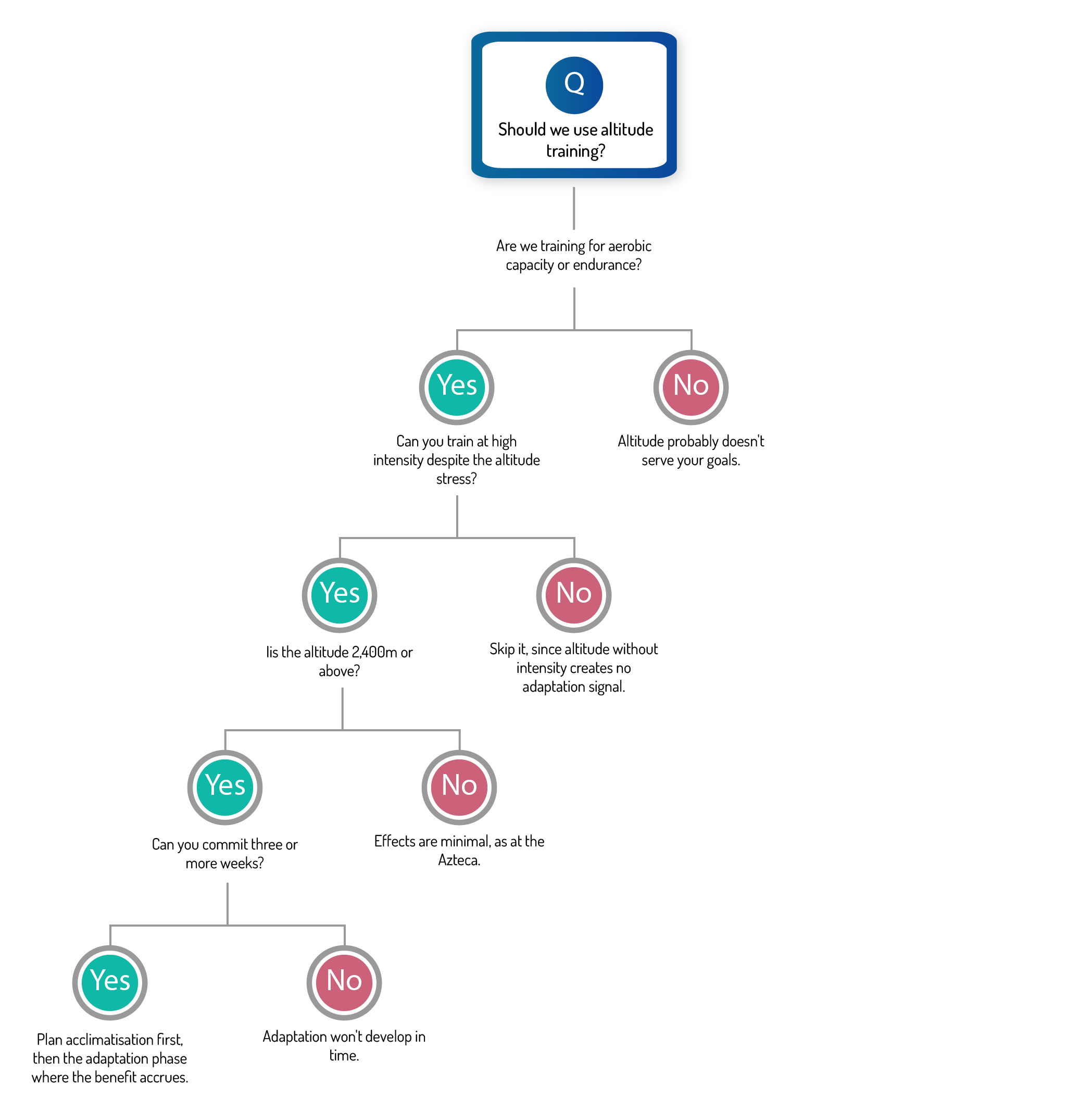
Long term, this year: Use the decision tree below with your Year 12/13 groups to build genuine evaluative skill around when altitude training is worth the disruption it causes.
Invitation to disagree
I know some of you will read this and think I'm being harsh on a profession that's already stretched thin. I don't mean to be. I know some will argue exam boards should reward simplicity, and I'd respectfully disagree. Simplicity that obscures understanding isn't simplicity. It's avoidance. If you disagree, or if you've found ways to teach this rigorously while managing exam board reality, I genuinely want to hear it. Use the comments, or email me.Closing
Our students deserve more than vague phrases and memorised mark scheme points. They deserve to understand why altitude affects performance, what happens in the body, and how to evaluate it like the exam actually asks them to. That's not asking too much. That's respect, for the subject, for our students, and for the sport they love.Thank you for reading. I'd be grateful for your feedback, especially if you teach this brilliantly in your own context.
Have a wonderful week.
James